
Every knowledge program seems to begin with the same request. A senior engineer is leaving in six weeks, and someone asks her to document the process she’s carried for years.
She returns a clean flowchart of the happy path. The drawing is accurate and may even be elegant. It leaves out the thresholds she watches, the conditions that make the standard procedure unsafe, and the supplier whose parts fail in humid weather. She doesn’t think of those judgments as separate knowledge. After years on the job, they feel obvious.
Six months later, a production line goes down and the knowledge base can’t explain what to do. The interview took place as per the process. Its transcript was chunked, embedded, and indexed, so the search returns the relevant passage quickly. The passage still can’t answer the question because no one asked the engineer to explain the judgment behind the procedure.
That gap now limits many enterprise AI programs. Organizations continue to improve retrieval over collections that omit some of their most valuable operating knowledge. Better ranking can help people find what was recorded; it can’t recover the expertise that never entered the collection.
The blind spot in enterprise knowledge systems
Michael Polanyi gave the problem its durable formulation in 1966: “We can know more than we can tell.” In The Tacit Dimension, he argued that competence depends on skill, perception, and judgment that resist full explanation, even when an expert sincerely tries to teach them.
In companies, tacit knowledge usually appears in three forms. Elicitable knowledge remains unspoken because nobody has asked a precise enough question, or because an expert assumes that everyone sees what she sees. Perceptual knowledge lives in trained attention: An engineer hears a bearing begin to fail, or a nurse notices that a patient looks wrong before a monitor changes. Collective knowledge resides in a team’s habits, standards, and shared sense of what a sound decision looks like in that organization. Each form requires a different method of transfer.
Preventive judgment creates another difficulty for the architect. A failure produces a ticket, an incident report, and a trail of messages. An experienced operator who quietly avoids a known failure mode on a Friday afternoon produces none of those records. The useful outcome is the absence of an event, so the data pipeline receives no trace of the decision that produced it.
Machine learning can infer rules that people struggle to articulate, provided the model sees enough representative examples. It’s difficult to find enough examples of rare expertise for training. A company may have only a handful of unusual incidents and one person who has learned, over decades, how to read them.
David Autor described this limit as “Polanyi’s paradox”: Many of the tasks that are hardest to automate depend on rules we can’t state. Modern machine learning works around the paradox by learning from examples, but the workaround weakens when examples are scarce. Fine-tuning can teach a model the company’s vocabulary and document formats. It can’t reconstruct decisions that left no data.
At the same time, the economics have changed. Much of a field’s documented best practice now appears in frontier-model training data and is available to competitors at roughly the same price and quality. The more widely explicit knowledge circulates, the more a company’s advantage depends on local judgment: the exceptions, thresholds, relationships, and practiced responses that its people have accumulated.
That makes elicitation an architectural concern rather than an offboarding chore. The organization needs a repeatable way to surface the knowledge that can be expressed, a route for the expertise that must be demonstrated, and enough humility to distinguish the two.
A protocol for elicitation
The central design question is straightforward: Which follow-up would prompt an expert to say the missing judgment aloud? The quality of the interview sets the ceiling for the knowledge base. The index determines how quickly someone can reach the resulting material.
Interviews can be made more reliable even though judgment itself remains highly personal. An expert may know that a particular supplier fails in humid weather. The interviewing protocol doesn’t need to possess that knowledge in advance; it needs to notice a phrase such as “we escalate if it looks bad” and ask the expert to define “bad” in observable terms.
Expert explanations tend to become vague in four places. An effective interview protocol asks targeted questions about each one:
- Thresholds: Which number, reading, or condition triggers the action?
- Exceptions: When does the documented procedure cease to apply?
- Evidence: What did the expert observe before reaching the conclusion?
- Escalation: Who becomes involved, and at what point?
These questions uncover the operational detail that runbooks often lack. They also identify a narrow, useful role for a language model during the interview: proposing the next question that turns a general statement into a usable rule. I’ve been building an open source toolkit, ExpertTrace, around that protocol.
The value appears in the difference between what an expert volunteers and what the same expert confirms after one focused follow-up. Consider a typical first answer:
We review high-risk use cases before deployment. If the risk seems significant, we escalate to the governance council.
The statement will embed cleanly and retrieve for a relevant query, but a new employee still cannot act on it. “Seems significant” supplies no decision criterion. A targeted follow-up produces something much more useful:
Escalation to the council is required when the use case touches employment, credit, or health decisions, or when model output reaches a customer without human review. Predeployment review is skipped for internal-only tools with no personal data, which is the exception people get wrong most often. If we cannot identify a named accountable owner, the review does not proceed, regardless of risk tier.
The second answer takes little additional time, yet it contains a decision rule, an exception, a recurring failure pattern, and a blocking condition. It can guide a real dispute instead of merely mentioning the subject.
The protocol needs guardrails. Limit the number of follow-ups; a long interrogation exhausts the expert and eventually produces agreeable noise. Keep the model focused on generating questions, and separate that task from compiling and validating the answers. An expert’s statement belongs in the record with its provenance and context. Whether the statement is accurate requires independent review.
The four-plane architecture
Elicitation is one part of a larger knowledge system. A tacit-aware architecture has four planes—capture, representation, serving, and transmission and each plane addresses a different failure in the movement of expertise. Figure 1 shows how the four planes work together and which forms of tacit knowledge each can reach.
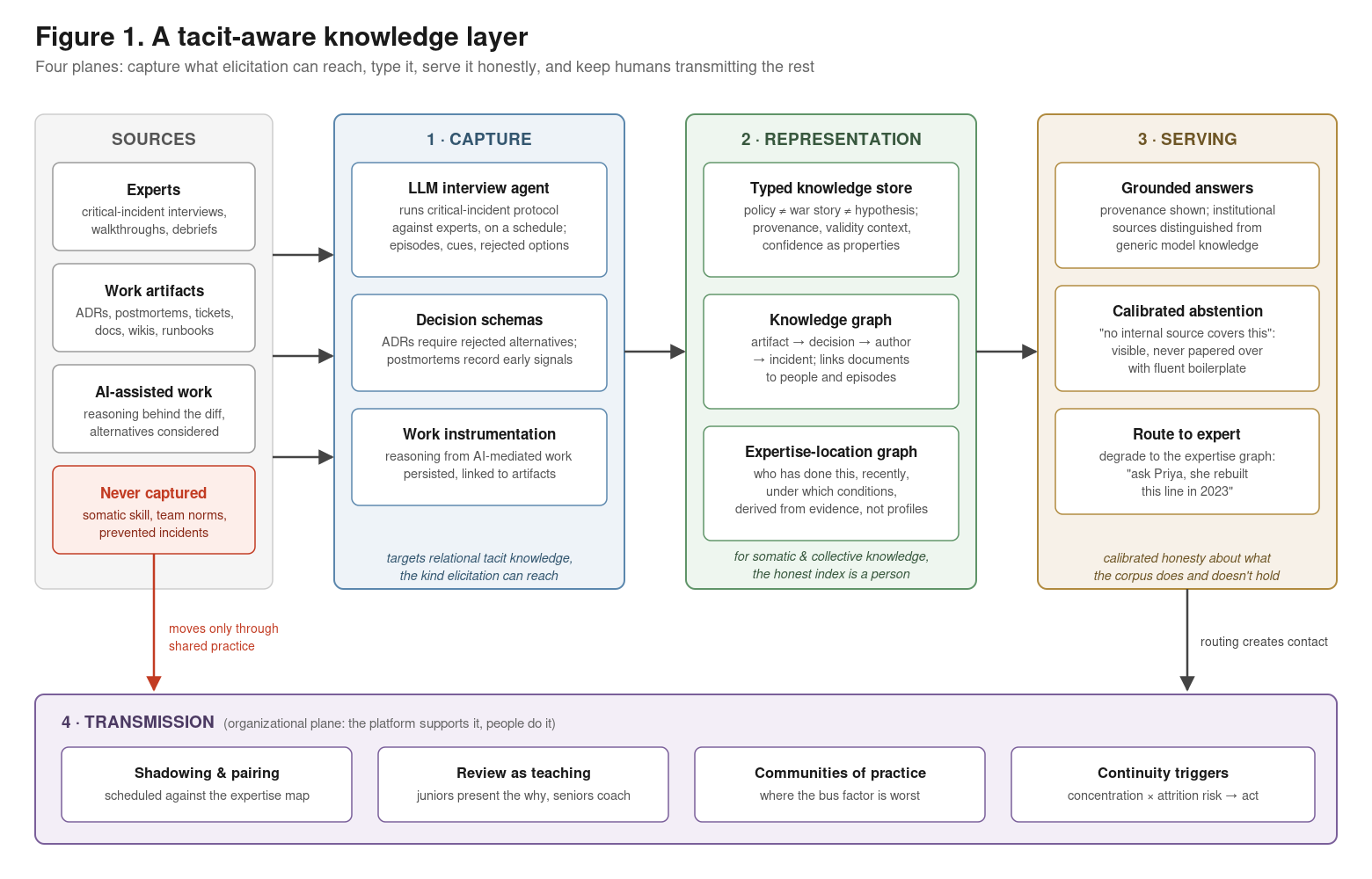
In the capture plane, structured interviews, incident reconstruction, decision journals, and observation collect more than polished procedure. Record the trigger, evidence, exception, and escalation path while the expert can still explain the surrounding conditions. Route perceptual skill toward demonstration and practice instead of forcing it into prose.
Once knowledge has been captured, the representation plane preserves the distinctions that make the material trustworthy. A compliance policy, a war story, and an untested hypothesis shouldn’t become interchangeable chunks. Carry provenance, confidence, and validity context—including the plant, time period, equipment, and conditions—as first-class properties. Extend the knowledge graph beyond documents to the people and episodes that produced them.
The serving plane then determines how that knowledge reaches users. Answers should cite retrieved evidence and show the source. When the collection can’t answer, the system should say so clearly and route the question to someone with relevant experience. “Ask Joe; she rebuilt this line in 2023” is more useful than a fluent paragraph assembled from weak evidence, and the referral restores the human contact through which difficult knowledge often moves.
The transmission plane completes the architecture by helping how expertise moves between people through shadowing, teaching, and communities of practice. The platform should detect when knowledge concentration and attrition risk converge, then trigger capture and apprenticeship before a notice period begins.
Gabriel Szulanski examined 271 observations of 122 best-practice transfers across eight companies and found that even willing teams struggled to reproduce methods developed elsewhere in the same organization. The difficulty often began with causal ambiguity where people could describe the steps without fully understanding why they worked. Receiving teams also needed enough context and experience to absorb and apply what they learned. Preparation, coaching, and time helped them rebuild the practice in their own setting. A repository could preserve the record; the receiving teams still had to turn that record into working knowledge.
Evaluating the knowledge layer
Retrieval precision and answer faithfulness show how well a system serves its existing collection. They don’t reveal whether the collection contains the knowledge on which the organization actually depends. That question needs a separate evaluation loop tied to capture priorities and transfer outcomes. Figure 2 shows how the loop moves from offline evaluation to abstention calibration and then to transfer outcomes.
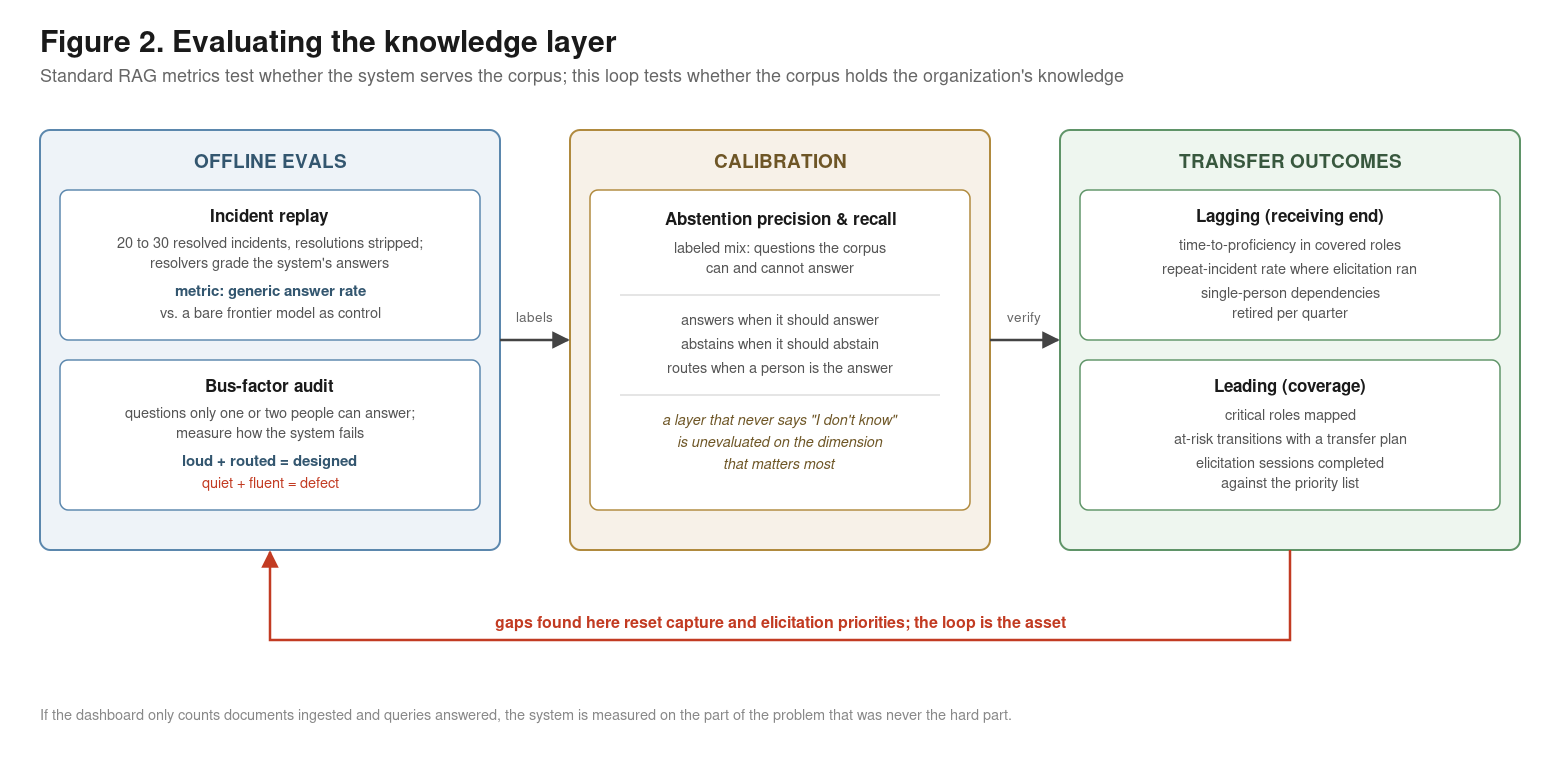
The evaluation begins with incident replay. Select 20 or 30 resolved incidents, remove the resolutions, and give the opening facts to the system. Ask the engineers who solved them to grade its responses. Compare those answers with responses from a frontier model that lacks access to the company’s collection. The gap reveals the generic-answer rate: how often the internal system merely restates public knowledge. If reviewers can’t tell the two sets apart, the pipeline adds little institutional value.
A bus-factor audit tests questions that only one or two employees can answer, and study how the system fails. A clear admission of uncertainty followed by a useful referral is healthy. Fluent boilerplate damages trust in every response, including the accurate ones.
Abstention calibration measures whether the system answers when evidence exists and declines when corpus can’t support an answer. Build a labeled set of answerable and unanswerable questions, then track abstention precision and recall as the collection grows. A system that never says “I don’t know” is unevaluated on the dimension that matters most.
Transfer outcomes complete the loop by measuring whether knowledge has reached the people who need it. Evidence of transfer appears in shorter time to proficiency, fewer repeat incidents after elicitation, and fewer critical responsibilities that depend on a single person. Document and query counts describe system activity; they don’t show whether someone else can now make the decision.
A strong knowledge system records what an expert said, preserves the conditions around the statement, and marks uncertainty. It also recognizes expertise that requires demonstration, apprenticeship, or team practice. Every evening, the people who carry that knowledge walk out the door. The architecture should be ready long before one gives notice.
Is cybersecurity part of your job in any way? If so, we’d like to know what you think for a report we’re writing. Just answer these quick 11 questions. Thanks in advance! Take the survey >