
Is the current furore in mathematics the canary in the coalmine for experimental science and knowledge work?
This post was originally published in Vanishing Gradients on September 11, 2026. It’s been updated to address the subsequent declaration by 25 Fields Medalists and the debate about AI, mathematical progress, and research incentives.
Science without understanding?
“For seven and a half million years, Deep Thought computed and calculated, and in the end announced that the answer was in fact 42—and so another, even bigger, computer had to be built to find out what the actual question was.”
―Douglas Adams, The Restaurant at the End of the Universe
I recently went back to Dresden for the 25th birthday of the Max Planck Institute (MPI) of Cell Biology and Genetics, where I did part of my postdoc. The MPI was founded to research the physical and biological mechanisms of cells to bridge the gap between the molecular and tissue scales. At the anniversary conference, Michael Bronstein (DeepMind Professor of AI, University of Oxford) delivered the keynote, “Biological Black-Box Data in the Age of AI.” His argument went something along these lines: Biological experiments should generate data optimized for machine learning, even when those measurements aren’t directly interpretable by humans. He argued for prioritizing scale over the quality of individual measurements, producing vast amounts of cheap, noisy data from which noninterpretable models can extract signal.
When asked whether such systems could produce the understanding offered by Newton’s theory of gravitation in a single equation (bridging the scales of an apple falling on your head to that of the moon and the tides), Bronstein responded that this wasn’t the goal: Black-box data and models would, if anything, produce equations with tens, hundreds, thousands, or more noninterpretable parameters. Outcome prioritized at the expense of insight and understanding. He suggested we could gain that understanding by interpreting the black-box models afterward.1 I was startled to see Bronstein bring such a worldview to an institute founded to understand molecular and cellular mechanisms and the emergent properties at the tissue level.
The MPI was unusual within the Max Planck Society for its collaborative structure, with directors leading relatively small groups alongside independent research groups. At the anniversary’s opening, founding director Marino Zerial explained how they had collaborated so effectively from the start. He said they shared a taste for mechanistic science. This made me think of how often we talk about “taste” and “judgment” when describing the human role in the age of AI.
The worldview that we don’t need understanding or insight isn’t new. In his 2008 essay “The End of Theory: The Data Deluge Makes the Scientific Method Obsolete,” Chris Anderson argues that big data allows us to skip hypotheses, models, and testing. Bronstein invoked Anderson’s vision of post-theory science in his MPI keynote, as he does here also, presenting DeepMind’s AlphaFold as an example of experimentally testable predictions without a human-understandable theory of protein folding. Part of Anderson’s project is to champion big tech, and the future of science becomes a vehicle for doing so. His essay ends: “What can science learn from Google?”
AI gives this worldview a new form: Machines can produce results that withstand verification while the understanding needed to explain them remains out of reach. Developing that understanding takes time, access, and collaboration. Whoever controls those conditions gains power over what people can understand and pursue.
An abundance of proofs
Mathematics makes this possibility particularly stark. I’m excited by AI’s potential to expand what we can discover. Fields Medalist Terence Tao has organized collaborative research combining mathematicians, AI tools, and formal proof verification. His questions about mathematics in the age of AI come from engaging with that potential and asking what we want it to serve.
Tao has noted that we’re producing more verified mathematical proofs that no individual human understands. A world of an abundance of verified mathematical proofs! Tao points out that our peer review, academic incentives, and journals weren’t designed for this abundance. The existing system is already broken, tying careers to publication counts, relying on researchers’ unpaid reviewing labor, and locking much publicly funded knowledge behind commercial paywalls. Reviewers already struggle to keep up with the volume of submissions. AI will multiply that volume far beyond what this system can handle.
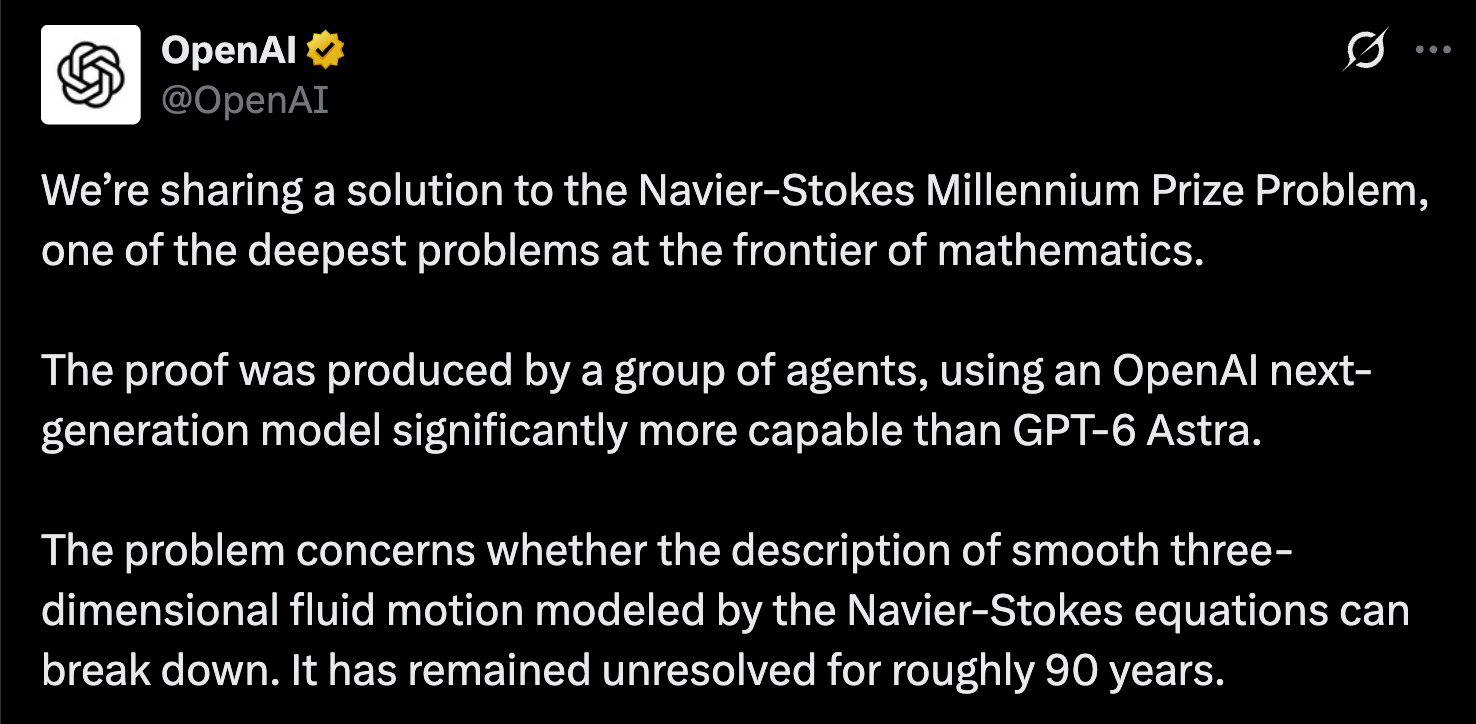
Tao also describes fruitful open problems as nonrenewable resources: problems whose pursuit can generate new techniques, collaborations, and understanding that extend far beyond the original question. Once the answer is known, the incentive to explore those paths can disappear. For example, 10,000 OpenAI agents working concurrently may have solved the Navier–Stokes Millennium Prize problem. (The announcement has also sparked a dispute over credit and competition, bringing the question of who controls mathematical discovery into sharp focus, which I’ll get to.) A common conceit in science and mathematics is that solutions open up new questions and fields of inquiry. Tao’s point is that the search for a solution does too. Tao argues that proposing a solution, discovering precisely why it fails, and revising it can reveal new insights into fluid mechanics. Knowing the final answer beforehand can discourage that exploration:
“The process of starting with one ansatz, discovering the precise obstruction preventing it from working. . .would almost certainly reveal important new insights about fluid mechanics.”
—Terence Tao, Mastodon, September 3
Late last month, probabilist Hugo Duminil-Copin gave another example: Unsuccessful attempts at a percolation conjecture led to collaborations and revived techniques that subsequently solved other problems. Both acknowledge AI’s capabilities while asking what the pursuit of mathematics should produce.
This brings me back to Bronstein’s proposal to recover understanding after building the model. Would interpreting that model give us Maxwell’s equations, and the understanding that connects electricity, magnetism and light? The promise feels a little like plugging Neo into a computer: “I know kung fu.” In the Matrix, downloading the knowledge gives him the ability. Receiving a machine’s result doesn’t do that for us. As Tao and Duminil-Copin describe, understanding why an approach fails changes what researchers try next, generating new questions, techniques, and collaborations. Recovering an explanation afterward may teach us something, but it can’t recreate the paths that understanding would have opened during the search.
A timeline of mathematical results
These questions are becoming pressing as results accumulate. Over the past year, AI systems have produced new mathematical constructions, tackled unpublished research problems and formalized existing proofs. Since July, announcements have arrived in quick succession:
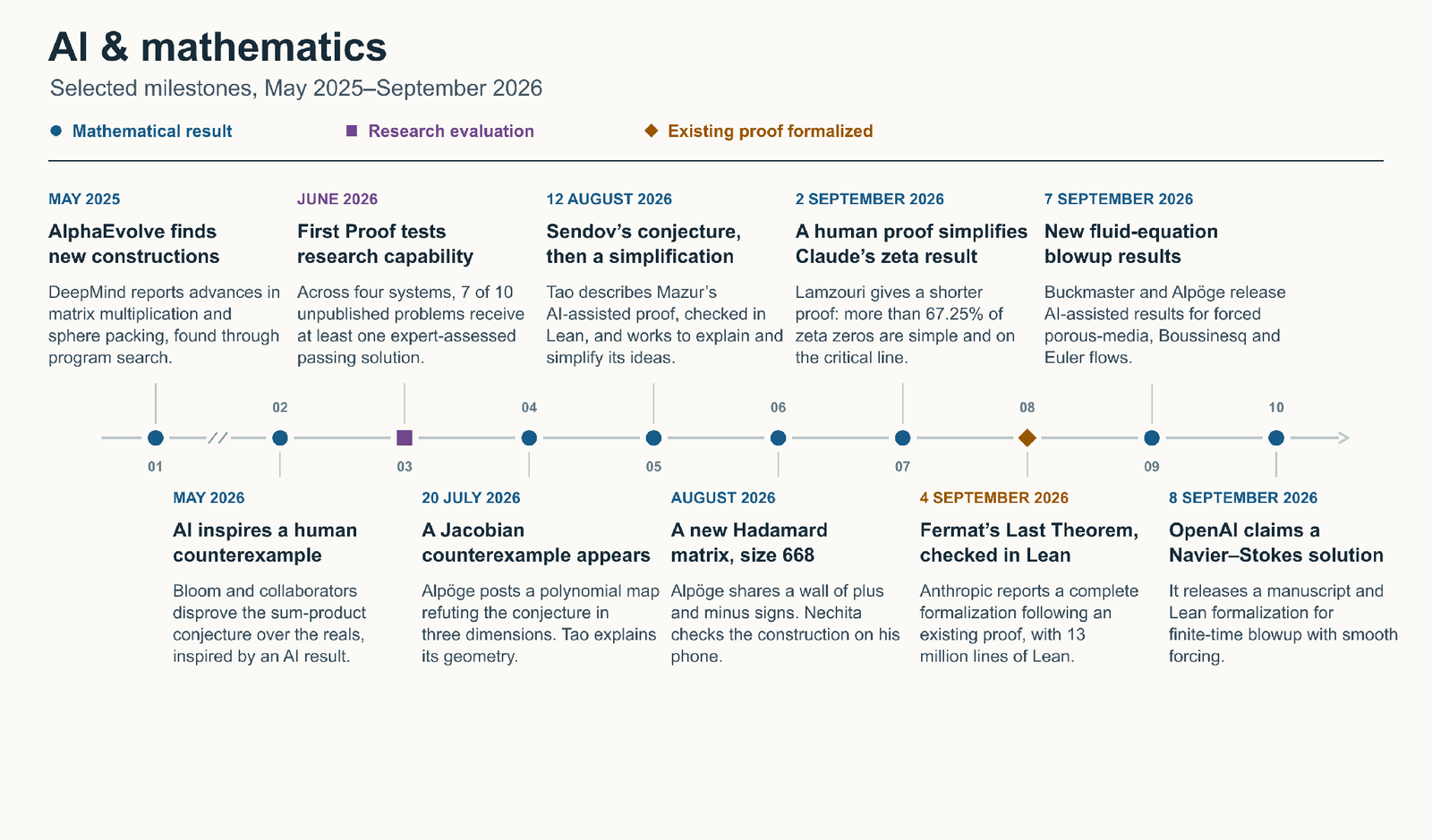
These achievements involve different kinds of work. Formalizing Fermat’s Last Theorem means making an existing proof checkable by a computer; finding a counterexample establishes something new. A system can produce a verified result while the work of explaining it remains to be done.
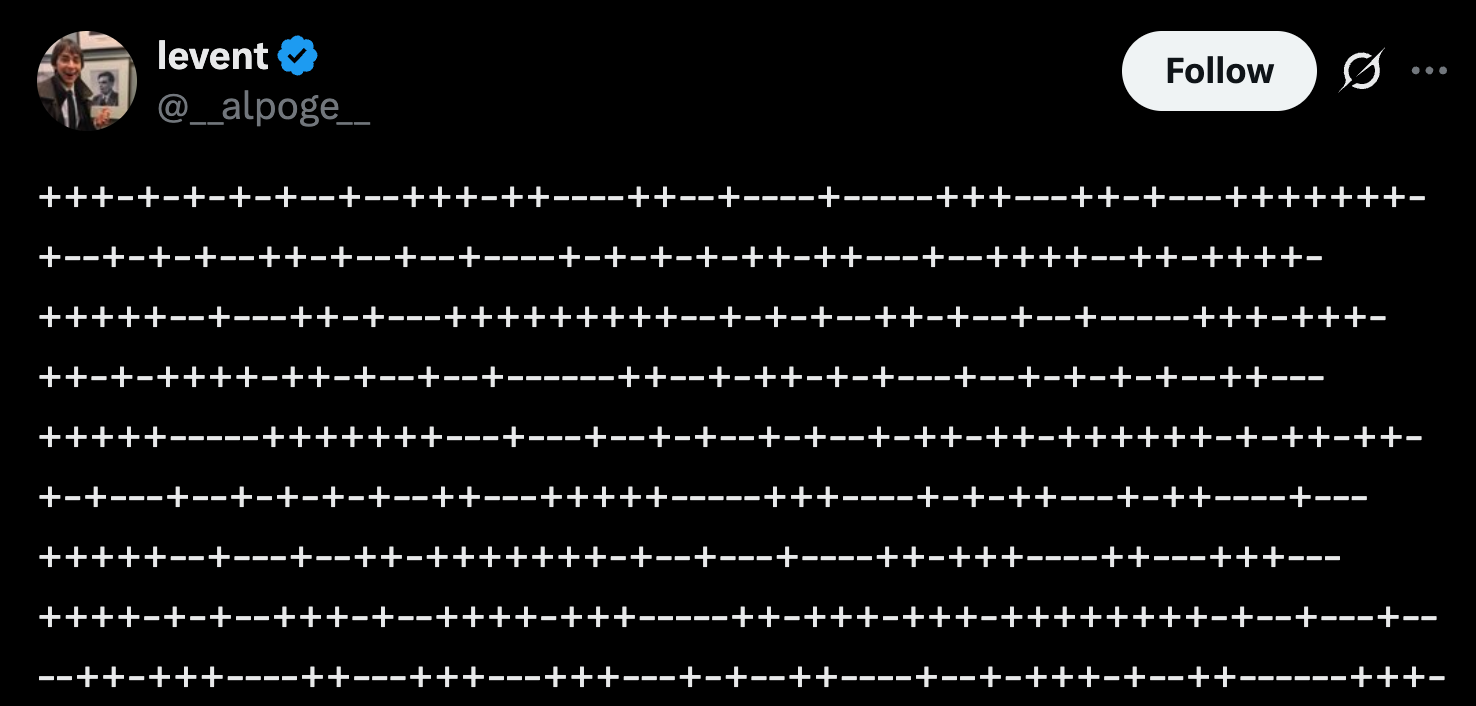
Some of that work is happening through wonderfully strange exchanges on X, where researchers post new results, check one another’s constructions, and develop explanations. It’s reminiscent of when science in Europe was people passing notes and sending letters on horseback:
- A wall of plus and minus signs: Levent Alpöge posted a newly constructed Hadamard matrix. Ion Nechita checked it on his phone while queuing for eclipse glasses.
- A formula overturning a conjecture: Alpöge posted a counterexample to the Jacobian conjecture, and Terence Tao subsequently explained its geometry.
- An AI proof followed by a simpler human proof: After Claude advanced a result about the zeros of the Riemann zeta function, number theorist Youness Lamzouri found a shorter argument. Thomas Wolf shared the development.
- A cryptography breakthrough announced as a number: Eric Lu posted a factor of RSA-260, letting anyone check the factorization.
Tao’s geometric explanation and Lamzouri’s shorter proof help turn verified results into mathematics people can understand and build on. Responding to an early draft in our Discord community, Carol Willing, a Python core developer, former Python Software Foundation director, and longtime leader of Project Jupyter, asked:
While I believe these tools have value for advancing science/math, do they have more value than a human scientist or group of scientists who can view and challenge open results?
If we judge value by who produces a result first, we miss what Lamzouri and Tao contribute by simplifying a proof or explaining its geometry. An answer can close off some paths of inquiry while creating others. I want much more of this: machines producing results that people can explore, explain and build on together. These exchanges depend on results being available to examine, researchers having time to understand them, and people being able to share what they discover. Those conditions deserve as much attention as the systems producing the proofs.
Why is this happening now?
Why the explosion in AI-generated mathematical results now? As Sebastian Raschka explains, reinforcement learning with verifiable rewards (RLVR) became a major technique in model post-training in 2025. The premise is straightforward: If you can computationally check an output, you can reward correct answers and update the model accordingly. Code can be run against tests; mathematical answers can be checked, and formal proofs verified by tools such as Lean, a proof assistant that checks each logical step against specified axioms and previously established results (recently used by Anthropic to formalize the proof of Fermat’s Last Theorem!). That provides feedback without a human grading every attempt. These checks also guide agents during problem-solving: An agent can propose a proof, use Lean to check it, and use the resulting errors to revise its attempt, repeating the process without a person checking every step.
You may ask, Why did coding agents become useful before we saw this explosion in mathematical results? Well, the labs had an immediate incentive to improve the tools they use themselves. Engineers building AI systems want better coding agents to help build those systems. Improve the machine that improves the machine. Mathematics benefits from the resulting capabilities too: agents that can write programs, run experiments, and work with automated checks.
Cost, competition, and credit
On September 11, 25 Fields Medalists issued a declaration warning that the race to solve benchmark problems was undermining mathematics. Some responses on X treated this as professional protectionism; others assumed that understanding would follow the proofs. That brings us back to Bronstein’s proposal, and to who gets to decide that producing results comes first while other researchers supply the explanations afterward.
Many assume that the goal of pure mathematics is to produce results. Tao’s point is that pursuing those results also develops methods, understanding, and people capable of asking better questions. Solved problems have served as a proxy for that broader progress. Goodhart’s law describes the danger of turning the proxy into the target. AI mirrors our incentive systems and is exceptionally good at pursuing what they reward. If schools reward the essay over learning, students will generate essays. If mathematical prestige attaches primarily to solved problems, labs have every incentive to produce them.
Producing results and developing understanding aren’t mutually exclusive, but the current system makes pursuing both prohibitively difficult. Frontier labs have strong incentives for outcomes rather than insight. (See, for example, Anthropic’s incentives for solving Millennium Prize problems with Claude pre-IPO, discussed in Gavin Baker’s commentary on Anthropic’s pre-IPO positioning; Samuel Kerr makes a related argument about OpenAI’s mathematical results and its IPO narrative.) OpenAI’s run involved 10,000 agents working concurrently for 88 hours. Abhishek Nagaraj, associate professor at UC Berkeley, calculated this would cost a regular user $20–$30 million in tokens.
NYU mathematician Tristan Buckmaster says OpenAI pressured him to publish without his collaborator Levent Alpöge, who works at Anthropic. OpenAI’s Sébastien Bubeck disputes his account. Buckmaster also describes how the pressure affected the mathematics: He and Alpöge had verified their proofs but wanted more time to understand them and produce readable explanations. Instead, they rushed to publish work they considered inadequately explained. If understanding is deferred until after the result, what ensures that anyone gets the time, resources, and access to develop it?
What’s worse is that we’re not even sure whether using OpenAI agents could result in them scooping you. It looks like they’re not sure either:
While unlikely, we cannot rule out that de-identified data derived from their usage of our products helped improve our models.
In “The End of Mathematics,” mathematician Daniel Litt imagines researchers withholding unfinished ideas for fear of being scooped. The collaborations Duminil-Copin describes depend on people being willing to share work before it succeeds.
What happens to mathematicians, and who controls mathematics?
If researchers stop sharing promising ideas for fear of being scooped, companies with the most computation gain greater control over what others can learn. A published proof may be available to everyone while the failed approaches and intermediate insights remain private. Threats to public research funding in the US compound that dependence: Companies supplying the resources gain greater influence over what science gets done. This brings us to Shoshana Zuboff’s questions about knowledge and power: “Who knows? Who decides who knows? Who decides who decides?” Who gets to pursue a fruitful question, and who determines whether the work behind its answer becomes shared knowledge?
The movement of AI researchers from academia into industry concentrates expertise alongside those resources. And I get it: If I wanted to return to doing research in depth, frontier labs would be among the most attractive places to work. Access to capital, data, computation, and incredibly talented colleagues can make research possible that would be difficult to pursue in academia. The attraction for individual researchers is clear, even as their collective movement gives companies greater influence over research priorities and leaves universities with fewer people to teach the next generation. Thinking about this brain drain, it isn’t lost on me that Bronstein is the “DeepMind Professor of AI” at Oxford. Corporate influence reaches into the universities themselves.
Students also need opportunities to develop the judgment we keep asking humans to exercise. Po-Ling Loh describes the difficulty of advising students and postdocs as AI changes research expectations. Choosing a fruitful problem, recognizing why an approach failed, and deciding what to try next are abilities developed through doing mathematics. If students delegate that work before developing those abilities, where will their judgment come from? AI could also help them explore more approaches and work through unfamiliar ideas, provided their understanding remains an explicit purpose of the process. That requires mentors with time to teach, and institutions willing to support work whose value includes what the researcher learns, even when a machine could produce the result faster.
When careers depend on producing papers, time spent explaining a result, simplifying a proof, or helping others understand it can compete with the pressure to publish the next one. Martin Hairer argues that authors should understand their arguments, trace ideas to their sources, and explain AI’s contributions. Those responsibilities become harder to fulfil when results arrive faster than researchers can absorb them. Universities, funders, and journals will help determine whether mathematicians can afford to do that work. If we value shared understanding, then developing explanations, teaching difficult ideas, and making proofs useful to other researchers need to count toward careers as well. Otherwise, the institutions asking people to exercise judgment may reward them for spending less time developing it.
Mathematics as the canary
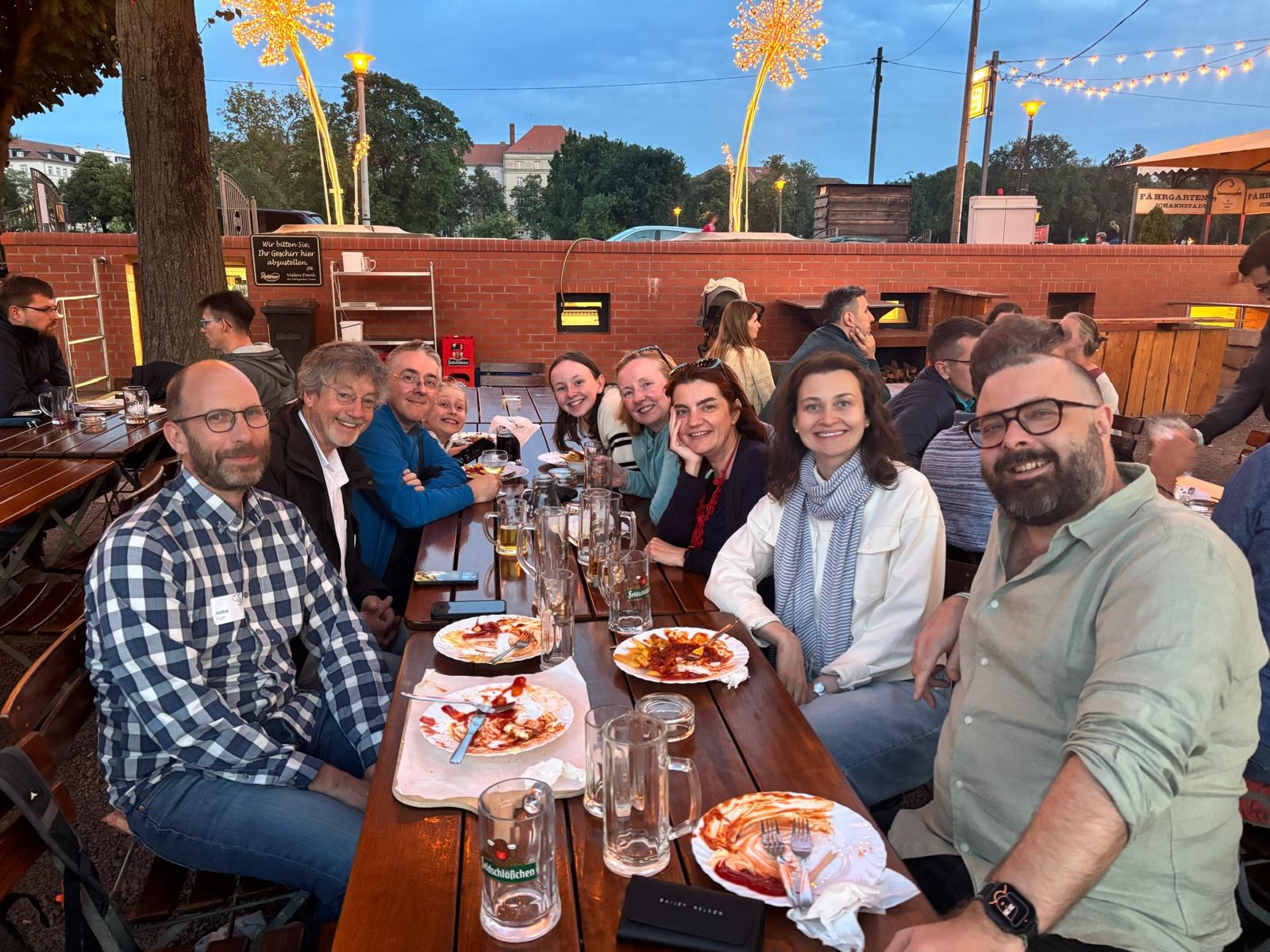
After Bronstein’s keynote, we sat in a Dresden beer garden eating currywurst and drinking radlers. It was late summer, and the conversations were wild. Cell biologists, biochemists, mathematicians, and engineers were asking what this future meant for them. Some were scared. Others thought it was inevitable and would turn scientists into something like artists. Because I now work in AI, people asked me, “Do you think this is where things are going?” They wanted to know what the human’s role would be and how scientific knowledge would be passed down. I started telling them about mathematics. The prospect of abundant results without shared understanding was already raising the questions we were asking over our beers.
In biology, a proposed result still has to meet the physical world: Someone has to prepare samples, run experiments, and measure what happens. Robotics and laboratory automation will let agents carry out more of that work, giving individual scientists the capacity to direct experiments that once required an entire group. Perhaps more scientists become PIs of automated labs, choosing questions and supervising agents and instruments. But the work being automated is also how students, postdocs, and technicians learn. Handling a sample, noticing something unexpected, and figuring out why an experiment failed develop judgment that directing a system may not teach. Who gets to acquire that experience before they’re expected to lead?
Researching a policy brief, building a financial model, or developing a product strategy helps people learn the territory in which they’ll make decisions. In my work with agentic data science, I encourage people to explore data cell by cell with an agent, because working through the analysis develops the understanding needed to decide what to ask next. Across knowledge work, these tasks are also how junior colleagues develop expertise. If we automate their production, how do we preserve the learning and judgment developed through doing them? We could increasingly depend on models to hold and transmit expertise, with knowledge passing from model to model, then to humans who consult them as oracles. Whoever controls those systems gains power over what we can investigate and learn. Human understanding has to be part of what we’re trying to produce.
What comes next?
Mathematician Jared Duker Lichtman has proposed a Mathematics Atlas Project to formalize the existing mathematical literature, arguing that sufficient funding and computation could make this possible within a year. A library of computer-checkable mathematics could let researchers build on established results with greater confidence, while agents help find connections and assemble arguments across fields. It could also become a resource for learning, if people can connect formal proofs to explanations they understand. Achieving that would require deliberate work on access, exposition and teaching alongside formalization. We have an opportunity to build tools that help people explore mathematics more deeply, provided we make that part of the project.
The MPI in Dresden was founded to understand how cells work, how molecular mechanisms give rise to the behavior of living tissue. I want AI to help us pursue that ambition, including through approaches we could never have attempted before. But human understanding belongs among the things we ask this work to produce, with time and resources devoted to developing it. So does the ability to share what we learn and choose what to investigate next. If we leave those decisions to the companies supplying the machines, we also leave them to decide what scientific progress is for.
👉 Want to understand how AI agents actually work? In Build AI Agents from First Principles, we’ll build an agent ourselves, then rebuild it with a modern SDK and MCP. You’ll leave with a working agent, code you can adapt, and the understanding to diagnose failures and decide what your system actually needs. 👈
Support Vanishing Gradients
Vanishing Gradients is independent, and most of the podcasts, workshops, articles, skills, and workflows I publish are free.
If you’d like to help keep it going:
- Become a paid subscriber. Your subscription supports the podcast, newsletter, and open resources.
- Share this post with a friend or colleague who’d find it useful.
- Subscribe to the events calendar for upcoming livestreams, workshops, and meetups.
- Subscribe on YouTube for full episodes, live builds, and recordings.
- Join us on Discord. Come discuss this piece, challenge the ideas, and compare notes on what you’re building with AI.
- Work with me. I help teams build and improve AI-powered products.
Footnote
- Bronstein and Naef propose an inversion: From “understand, encode, and then simulate” to “encode, simulate, understand,” recovering human understanding post hoc through mechanistic interpretability of black-box models. Useful scientific models may require enormous numbers of parameters. But predictive success alone does not tell us whether interpreting those models will give humans an understanding of the phenomena they describe. They offer negligible evidence that this will yield the kinds of physical and biological understanding we gain through relativity, quantum theory, or the double-helical structure of DNA. And even if it does, understanding developed afterward may not replace the understanding that guides inquiry, generating new questions and approaches along the way. ↩︎
Is cybersecurity part of your job in any way? If so, we’d like to know what you think for a report we’re writing. Just answer these quick 11 questions. Thanks in advance! Take the survey >