
A lot of professional writers say they never do it. And for writers who do, the consequences can be serious. Book contracts have been withdrawn. People have lost jobs.
I have a contrarian view. I say AI is a medium, like painting, sculpture, photography, music, or language itself. If AI is a medium, it is a field of possibility from which humans can and will summon up and communicate insights, truth, beauty.
Last year I asked Claude to write an essay from its own point of view about a conversation we’d been having. I published it as “Why AI Needs Us.” While I named Claude up front as the author, in the afterword I disclaimed that, saying “I am the author of this essay, though Claude wrote every word.” I pulled it out of the latent space of possibility by what I asked for and how I asked, even though Claude came back with turns of phrase I’d never have used on my own. In the course of our hours-long conversation, we made something together. That wasn’t the machine replacing me; it was me exploring a new instrument.
If AI is a medium, it will take time for its possibilities to unfold, discovery on discovery. In Western painting, think of the progression from the flat, stylized religious art of the Middle Ages to the luminous colors of Giotto, the explosion of technique and realism in the Renaissance, and the many stages since. Greatness in the medium has many faces, not one. Botticelli, Michelangelo, Leonardo are all names to conjure with, but so are the very different visions expressed centuries later by Monet, Van Gogh, Picasso, O’Keefe, Kahlo, Frankenthaler, Haring, Banksy.
If AI is a medium, the idea that you can’t write with it will someday seem as odd as the idea that you can’t make a good portrait or landscape with a camera, only with paint or pen and ink. Technical innovations have often changed the nature of art. Researchers have shown that people feel cheated when they receive a personal message such as an apology that was written with AI. Automating a supposedly personal message is indeed a kind of deception. But we don’t think that Leonardo was cheating when he used a camera obscura to perfect perspective in painting, or that John Lasseter was getting away with something because he created Toy Story with a computer instead of painstakingly animating it by hand.
Ted Chiang wrote an essay called “Why A.I. Isn’t Going to Make Art,” which talks about both art and writing. He observed:
Art is notoriously hard to define, and so are the differences between good art and bad art. But let me offer a generalization: art is something that results from making a lot of choices. This might be easiest to explain if we use fiction writing as an example. When you are writing fiction, you are—consciously or unconsciously—making a choice about almost every word you type; to oversimplify, we can imagine that a ten-thousand-word short story requires something on the order of ten thousand choices. When you give a generative-A.I. program a prompt, you are making very few choices; if you supply a hundred-word prompt, you have made on the order of a hundred choices.
I agree with Ted about good art or writing as the result of many choices, but I can’t agree with his conclusion that AI can’t be used for writing, art, or other creative work because it lets you get away with minimal effort. In my opinion, this is what Frank Herbert once described to me as a “Jesuitical argument,” which he defined as “one you can always win as long as you control the givens.” Yes, AI isn’t going to create art on its own, any more than a camera or a set of oil paints will. Yes, art requires effort and expertise. Yes, AI won’t create art from a hundred-word prompt. But nonetheless I believe humans will create art with it.
Even the “hundred-word prompt” is a bit misleading. The choices expressed by a prompt are not limited to the number of words in it. A lifetime of reading, thinking, conversing, formulating might have led to that moment of expression. Leonard Cohen confessed to Bob Dylan that he had reworked “Hallelujah” over and over for two years (later admitting it was actually five), while Dylan claimed to have written “Blowing in the Wind” in 10 minutes. Even though Cohen appears to have labored far more over his work, and Dylan’s song spilled out like magic, both are masterpieces. The choices were made not just in writing the words but in the inner life of the author. So too, the prompt that one person brings to an AI may contain multitudes, while another makes only a humdrum provocation.
Photography gives a less anecdotal counter-example. A painter decides on every brush stroke, thousands of them. The photographer decides on the subject, the angle, the time of day that will provide the best light, the exposure, the speed, the focus, and during developing (pre-digital) the chemistry, but there’s no question that the practitioner of one of these art forms makes far more individual decisions than the other.
When the daguerreotype was introduced in 1839, portrait painter Paul Delaroche is supposed to have said, “From today, painting is dead.” Though widely quoted, that line is probably apocryphal. Delaroche’s own writing at the time called photography “an immense service to the arts.” He was probably thinking of the way photography would save the hours a sitter would need to spend holding still in front of the painter, allowing the artist to work from that captured image, not that photography would become an art in its own right, but whatever. Baudelaire definitely hated it, though. In his 1859 Salon he called photography “art’s most mortal enemy.” So Ted Chiang is in good company.
Painting didn’t die, but it did lose its position as the dominant way of representing people and places. Meanwhile, photography became a distinct art form. Photographers like Alfred Stieglitz and Dorothea Lange captured images that were not merely of documentary value but true art. Ansel Adams created stunning landscapes. Eventually, the ubiquity of cheap cameras led to an explosion of photo slop, boring home slide shows evolving into the cascading imagery of social media. Yes, a river of slop, but even now one carrying nuggets of gold.
Ted directly addressed this history:
When photography was first developed, I suspect it didn’t seem like an artistic medium because it wasn’t apparent that there were a lot of choices to be made; you just set up the camera and start the exposure. But over time people realized that there were a vast number of things you could do with cameras, and the artistry lies in the many choices that a photographer makes. It might not always be easy to articulate what the choices are, but when you compare an amateur’s photos to a professional’s, you can see the difference.
Photography continued to evolve, birthing moving pictures as a new branch of the evolutionary tree. The first movies were filmed stage plays. Edwin Porter, D.W. Griffith, and other pioneers began the long process of figuring out how to use it more creatively. That evolution still continues today, over a hundred years later. Ted’s point about choices fits right into that history. Figuring out a new medium means expanding the range of choices that are possible with it.
That’s about where AI writing is now. Most of what gets produced today is a camera pointed at a stage. The question isn’t whether slop exists. It obviously does. It isn’t just social media but also scientific journals that are being overwhelmed with it. But what we’re working out now is what the equivalent to the close-up and the cut and the CGI will turn out to be. Once we do that, there will be people who are masters at summoning words from an LLM, just as there are masters with a camera and the stories you can tell with it.
I wrote to Ted after I reread his piece. His reply included this wonderful bit:
This notion of “a concentrated form of intention” is also applicable in domains that are not traditionally considered art; good work of any sort is likely a result of concentrated intention. Not all of anyone’s writing needs to reflect their deepest thinking, but I suspect the very best examples of anyone’s writing will….Generative AI promises increased quantity without a decrease in quality, which is very seductive; I have serious doubts about whether this is possible, but even this is a separate claim from the idea that generative AI could lead to increased quality in any dimension.
I love Ted’s framing of good work as the result of “a concentrated form of intention.” And yes, people can become overly reliant on AI; that may result in an increase in the amount of mediocrity that is passed around. But I disagree with Ted’s idea that humans working with AI cannot do high-quality work. For all its weaknesses, AI is a better writer than the average human. So there’s one kind of step up there. How much more of a step up might we get when good writers, using AI as a tool, bring to bear a concentrated form of intention? We just don’t know what this looks like yet.
But perhaps more to the point, the form that concentrates intention may be different for different people. Neal Stephenson writes his books longhand. He thinks it makes them better. Most people would not share that opinion. The tools we use do change how we write, though. I am old enough to remember writing my first books on a typewriter, where cutting and pasting was a literal act. I periodically had to retype the whole thing to get a clean start before I could see my way forward. When I started using a word processor, the ease of revision felt disconcerting, and it changed how I engaged with the material. At first I felt a bit disconnected from the focus that I felt when making pen and ink corrections to a typescript, which then had to be retyped. But as I became more accustomed to word processing, I realized I could engage differently, with less attachment to what I’d already produced, more flexibility in rearranging it, and more willingness to throw it out completely and start over. The transition to writing with AI feels similar, though I suspect it may take a while for people to accept that.
So when someone like MG Siegler says that
“quality aside, I personally don’t see the point because most of what I get out of writing is from the process itself. From thinking to choosing what words to use—and just as importantly, what words not to use. It’s a bit like having a robot run a marathon for you.”
I agree with him on the value of the process, but his analogy goes far astray. Writing with AI is more like riding a pedal-assist electric bicycle. The speed and distance that you can go is proportional to the effort you put in. The analogy is not perfect, because in the case of AI, the motor can also be operated in “no-pedal” mode. Perhaps that imperfection in the analogy suggests a direction for improvement in AI. Electric “mopeds” let you ride without pedaling. But pedal-assist bikes are significantly more common than mopeds. Why? Adding pedals and making the motor turn on only when pedaling kept e-bikes legally classified as bicycles rather than as motor vehicles. I could see leaning into that notion and building affordances that require and reward concentrated attention even more than today’s models. Imagine, for example, AI models tuned for writing that produce notably better results in response to increased effort. Oh wait. They already work that way. But maybe there are ways to increase the incentive to pedal.
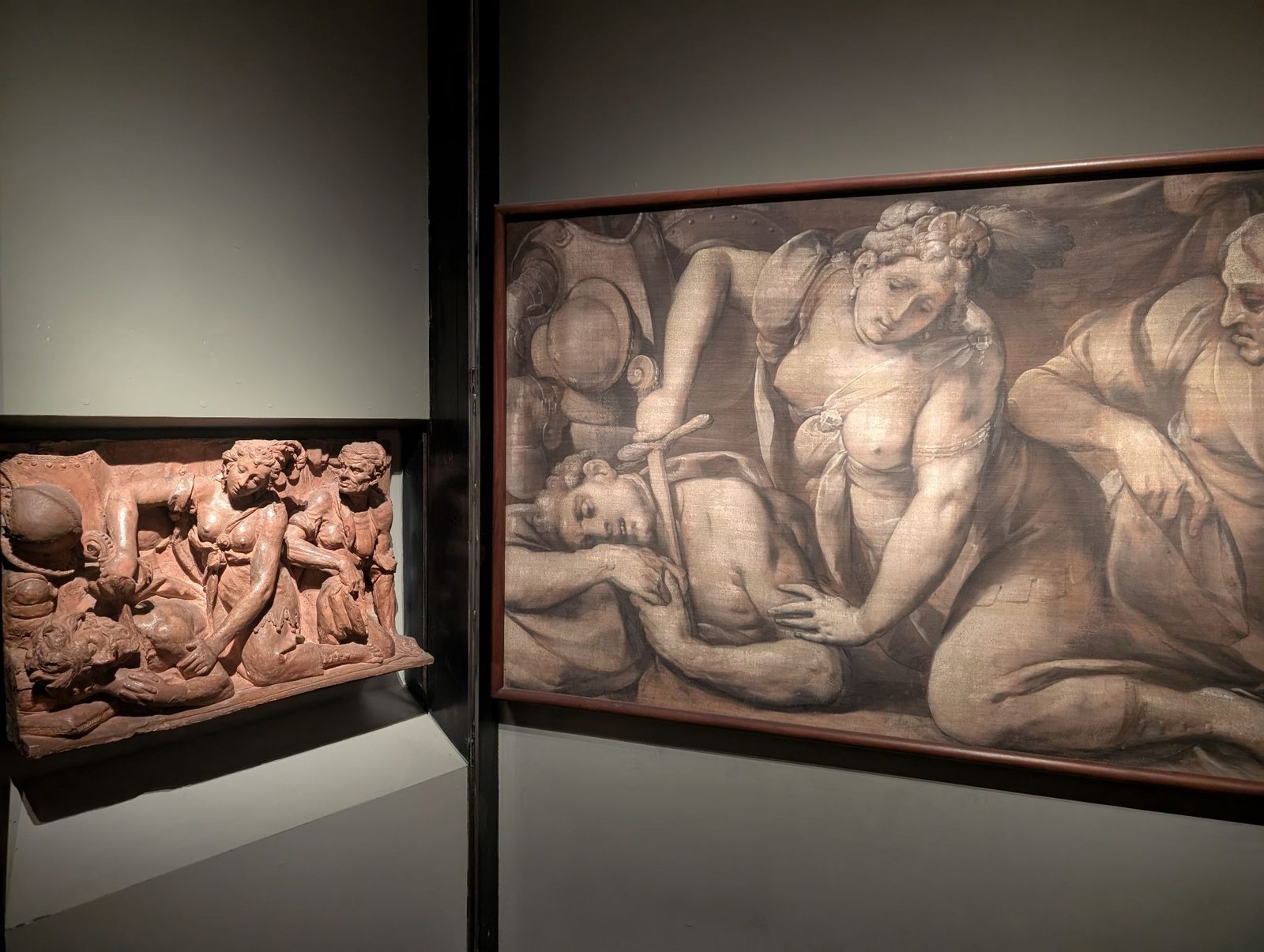
There’s more. Every art form benefits from first drafts that are refined into a final product. I was visiting the Duomo Museum in Milan recently, and was struck by the displays of pen and ink drawings that were turned into plaster casts that were later turned into marble sculptures installed high up on the walls of the cathedral, each draft realizing the creator’s intent in a more difficult medium. In the example below, you can see that the changes are not merely mechanical.
You can see this same progression in programming. Vibe coding produces a working prototype. If you publish it as is, you will likely soon understand that it needs further refinement. But it has allowed you, perhaps a nonprogrammer, to express your ideas in a way that you couldn’t do with a sketch, a paragraph or two, or even a nicely produced Figma mockup. And in the hands of an experienced engineer, AI can do far more. Among other things, it can be used to produce boilerplate code for common tasks, so the engineer can spend attention on the part he or she actually cares about. The same split is coming for prose.
Take my own process. Sometimes, writing from Claude or ChatGPT needs only a thoughtful prompt and a quick review before I send it on its way. The other morning, for example, I had an extremely interesting exploratory meeting with the CEO of another company. Both of us were using AI notetakers. I found the meeting sufficiently provocative that I wanted to share it with some members of my team. Rather than passing on the raw transcript, which included some chitchat and some extraneous topics, I asked ChatGPT to produce the gist of the parts of our conversation that focused on AI transformation and how O’Reilly and this other company might work together. This is a big win over the alternative: calling a meeting and recounting the conversation, or setting up a second meeting so my team could hear the story for themselves. Instead, we can move much more quickly to a productive next-stage meeting with the other company. I was quite happy to call ChatGPT the author of these notes.
I also use AI fairly extensively for routine writing, such as the “takeaway” posts I write from my Live with Tim O’Reilly interview show or events like AI Codecon. This is copy that I simply would not have time to produce without AI. Claude starts by providing a useful summary of the conversation. It’s got a lot of raw material to work from: my questions, the guest’s answers, our conversation with all its tangents. Yes, I could go back and quarry that myself from the transcript, but I mostly don’t have the time. Now I can ask Claude to read the transcript and spit out both a set of suggestions for the best video clips for social media and a serviceable first draft that quotes heavily from the original. Claude doesn’t write in a vacuum. The framing comes mostly from the words and observations made by the human participants during the event, plus the prompt I’ve provided and the context the model has learned from my edits to previous iterations of the same kind of writing. Because yes, then I rewrite. Sometimes, the AI has captured a lot of what I was looking for, and some of its prose survives. At other times, it is completely overwritten. I show Claude what I’ve made of what it gave me, and try to teach it to do better work next time.
For a thought piece like this, I write unaided if I have time. But even here, I often think of something to write while I’m on the go. If I wait till I’m at my desk, I may never get back to it. So I spill out my unstructured thoughts, and ask Claude to put them in order. They are mostly my words, but Claude has given me a reasonable first draft from them. Most importantly, it captured my thinking in the moment when it was fresh. (Wallace Stevens: “A poem is the cry of its occasion.”)
As I work through that draft, rewriting, I may ask for historical detail, links, verification of whether I’ve got my facts right, or what I might be missing. (For example, it was Claude that read my account here of photography and suggested, “You really ought to engage with what Ted Chiang has written about this same topic” and gave me a link to look at. I had read Ted’s piece when it came out, but forgot about it. Now I reread it, thought about it in the context of what I was writing, and worked it into my narrative.) To be quite honest, by the time I was done, I probably spent considerably more time than if I’d just dashed my thoughts off unaided.
In the case of this essay, I started with a 300-word prompt in a spare moment. Claude produced a 660-word slightly expanded draft that developed a few areas I’d asked for, but mostly restated the words from my brainstorming prompt a bit more cleanly. Then I followed up with a request for some fact checking and ways to make it more concrete (which is where I got the suggestion to engage with Ted Chiang). I used that draft as a starting point for what is now a 3,000-word essay. There are perhaps 40 or 50 words supplied by Claude, including the quotes from Delaroche and Baudelaire, which resulted from my request for research on early reactions to photography. (I had read Baudelaire but I’d never heard of Delaroche. I verified both quotes by checking the original sources and reading a bit more about the ferment of the time.)
I suspect that for most of us, having AI as a research assistant and a copy editor will make us a better writer. I’m not saying that Claude is doing for me what Max Perkins did for Fitzgerald and Hemingway, or what Ted Sorensen did for JFK, but then, I’m not Fitzgerald or Hemingway or JFK either. But it’s worth remembering that even great writers often don’t do it all on their own.
I’m proud of the way I use AI in my writing. I’m still making very granular choices. If it’s going out under my name, I make sure I’m happy with every word.
I’m not saying we should give AI slop a pass. I hate it as much as the rest of you, and I react badly when people send me unedited AI output as if they’d written it. But I’ve got nothing against those who use AI as a power tool to get more done or to deepen the writing that they are doing. I judge the output, not the means used to produce it.
We’re in the early days, still shooting filmed stage plays. The masters of this instrument will uncover themselves. When they do, what they produce isn’t going to be slop. In the meantime, I don’t think we should be shooting down people who are trying to push AI’s limits in writing or art. Writers should be trying to figure out the medium, just as software developers are doing in coding.
. . .
And be sure to join us at AI Codecon: Building with Open Source AI on August 31, a free half-day virtual conference. You’ll hear from leading developers and technical experts working with open-weight models, self-hosted infrastructure, and real-world AI workflows, and learn how building in the open gives teams more control over costs, data privacy, and what they ship. Register today to save your spot.