
Organizations today often expect their managers to lead distributed teams across time zones and cultures where alignment, communication, and trust directly affect team performance. Now add the rapid integration of AI to the mix. Managers must now also guide their teams through new agentic workflows and AI-augmented productivity, and the cost of poor alignment scales at machine speed.
As teams become more distributed and workflows become more complex, the cost of an untrained manager is a risk your organization can’t afford. By prioritizing programs that emphasize real-world application over abstract theory, you future-proof your organization and ensure your managers are equipped to lead in an AI-driven world.
Successful leadership development is a continuous loop of learning, practicing, and reflecting. The O’Reilly learning platform supports this process with practitioner-led training and role-based paths designed to turn your technical experts into strategic leaders and keep their skills fresh for the long haul. Schedule a demo today.
Why it’s important to develop your managers into leaders
Gallup’s Q12 meta-analysis, which analyzed data from 3.35 million employees across 347 organizations, found that highly engaged teams outperform low-engagement teams by 23% in profitability.
Gallup’s broader research also reports that managers account for at least 70% of the variance in employee engagement scores. That means underinvesting in management development directly hurts output.
Good managers help create an environment in which their employees can succeed, negotiating challenges with processes and performance. Ineffective managers may ignore emerging issues they feel unequipped to deal with, and the longer they go unaddressed, the more the impact compounds.
A three-month delay in addressing underperformance can lead to missed deadlines that set back product launches and other corporate goals, as well as increased workload for other team members, declining morale, and a higher risk of attrition.
If the underperforming employee is let go, replacing them could cost nearly twice their annual salary, and that’s before accounting for lost productivity.
Build the skills your teams need
Give your teams the O’Reilly learning platform and equip them with the resources that drive business outcomes.
Start nowCore competencies every new leader needs
You don’t solve leadership skills gaps with e-learning modules on the latest business theory. The leadership development programs that work best are built on repeatable behaviors that enable managers to handle real-world complexity.
- Coaching: Asks questions that help team members reach their own solutions rather than prescribing answers.
- Strategic thinking: Connects daily team priorities to quarterly business goals in team meetings.
- Change management: Explains the rationale for organizational shifts, such as the integration of new AI tools, before announcing the changes.
- Emotional intelligence: Regulates visible stress responses during high-pressure sprints or difficult reviews.
- Communication: Adjusts message format and frequency to meet each stakeholder’s needs.
- Delegation: Assigns ownership with clear success criteria, then steps back without micromanaging execution.
- Decision-making: Documents and shares the reasoning behind significant decisions so the team can learn patterns and understand the “why.”
- Performance management: Addresses underperformance with specific, behaviorally grounded feedback rather than general dissatisfaction.
Manager leadership development delivery options
No single format fits every organization. The table below compares the four primary approaches:
| Format | Typical cost range | Ideal use case | Key advantage | Limitation |
| On-site workshops | High (venue, facilitator, travel) | Cohort bonding, senior leader alignment | Deep practice with real-time feedback | Hard to sustain behavior change postevent |
| Live virtual cohorts | Moderate | Distributed teams, regional rollouts | Peer learning across geographies | Requires scheduling discipline across time zones |
| Self-paced e-learning | Low to moderate | Scale, foundational knowledge | High accessibility, broader topic coverage | Low accountability without structured reinforcement |
| Blended models | Moderate to high | Most organizational contexts | Combines practice depth with scheduling flexibility | Requires stronger program management |
Global organizations need scalable ways to develop managers across multiple geographies without increasing program complexity. Virtual cohorts combined with self-paced learning often offer a flexible, cost-effective approach to enable shared learning experiences while reducing program management overhead.
How to evaluate leadership development platforms
Choosing among leadership development platforms comes down to five criteria. For each, push vendors with specific questions:
- Curriculum depth: Does the content cover real leadership challenges alongside theory? Are modules updated as business contexts evolve? Can the curriculum be sequenced by role or tenure?
- Facilitator expertise: Do facilitators have direct people-management experience? Can you review sample session recordings? Are the instructors theorists or practitioners?
- Measurement tools: How does the platform assess behavior change beyond measuring course completion? Can it integrate with your existing performance data?
- Support resources: Are coaching or peer-learning touchpoints built into the program? What reinforcement resources exist between modules?
- Cultural fit: Can content be localized for different regions? Does the platform reflect diverse leadership models rather than a single cultural default?
Common trade-offs buyers face: Cost scales with customization, personalization shrinks as cohort size grows, and speed-to-launch often compresses the depth of needs diagnosis.
The O’Reilly learning platform helps organizations navigate these trade-offs by combining role-based learning paths with both live virtual training and self-paced courses, so managers build skills in context rather than through passive content consumption.
Implementation timeline and checklist for managers to leaders program
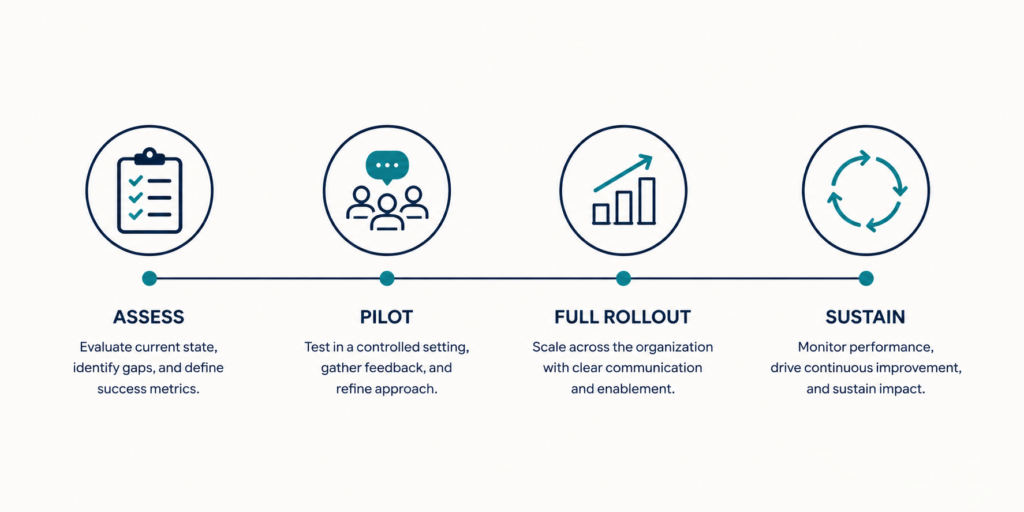
Use this realistic, four-phase timeline to launch, scale, and measure your manager development initiative.
Phase 1: Assess (weeks 1 to 4)
- HR leads competency gap analysis using surveys and performance data.
- Stakeholders validate priority development areas.
Phase 2: Pilot (weeks 4 to 12)
- A selected group of managers and practitioners completes the first cohort.
- Facilitators and HR collect feedback on content and delivery.
Phase 3: Full rollout (months 2 to 9)
- Scaled delivery across the manager population.
- Senior leadership reinforces key behaviors on the job.
Phase 4: Sustain and iterate (ongoing)
- Quarterly check-ins assess behavior transfer.
- Program content refreshed based on emerging needs and outcome data.
Turning potential into performance
The gap between a high-performing individual contributor and a high-performing leader is not filled by time or tenure. It is filled with intentional, behavior-based development. As teams become more distributed and workflows become more complex, the cost of an untrained manager is a risk your organization can’t afford.
Successful leadership development is a continuous loop of learning, practicing, and reflecting. By prioritizing programs that emphasize real-world application over abstract theory, you future-proof your organization and ensure your managers are equipped to lead in an AI-driven world.
The O’Reilly learning platform supports this transition with practitioner-led training and role-based paths designed to turn your technical experts into strategic leaders.
FAQ
Program costs vary widely depending on format, cohort size, and customization. While some facilitated programs come at a premium, many organizations are adopting scalable models that combine live and self-paced learning, delivering consistent development across teams at a significantly lower cost.
Most modern platforms offer integrations with common human resources information systems (HRIS) and learning experience platforms, so progress data can feed directly into performance review workflows without manual reporting.
Connect the program proposal to a business outcome executives already care about, such as regrettable attrition, loss of productivity or motivation, or a recent engagement survey result, and present a concrete measurement plan alongside the investment ask.
Live virtual cohorts with structured peer interaction tend to work well for distributed teams because they build relationships across time zones while keeping scheduling manageable, particularly when paired with asynchronous reinforcement content between sessions.
Start by defining the specific business outcomes you expect to shift, such as retention rates or team productivity metrics, then track observable manager behaviors on the job as the leading indicator that those outcomes will follow.