November 2018
Intermediate to advanced
70 pages
1h 30m
English
In this chapter, we take a closer look at how Danske Bank is achieving high-impact business outcomes by fighting fraud with machine intelligence.
As discussed in Chapter 5, Danske Bank was struggling to mitigate fraud by using legacy detection systems. With a low 40% fraud detection rate and a 99.5% rate of false positives, it was clear the bank needed to modernize its defenses. To do this, it made a strategic decision to apply new analytic techniques, including AI, to better identify instances of fraud while reducing false positives in real time.
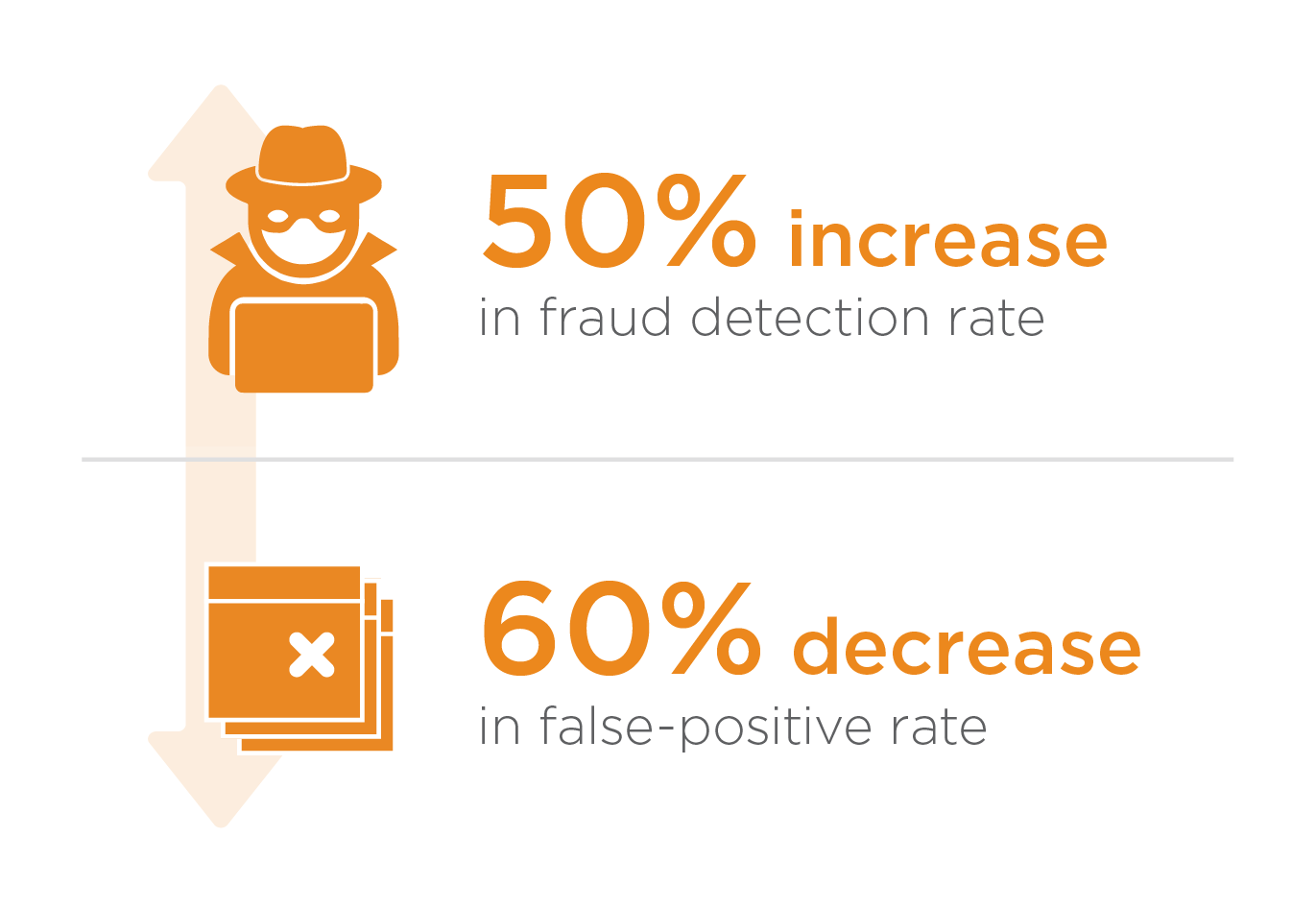
In partnership with Teradata Consulting, the bank was able to develop analytic solutions that take advantage of its unique data and provide a significant improvement over its previous rules-based engine, reducing false-positive detections of fraud by 60% with machine learning (with expectations to reach as high as 80% using deep learning), and increasing the true-positive detection rate by 50%, as illustrated in Figure 6-1.
The project evolved through several phases. First, the team laid the foundation for the analytics platform and got the data plumbing in place that would serve the machine and deep learning models. Then, the team trained, tested, and deployed machine learning models before moving ...
Read now
Unlock full access


 O’Reilly covers everything we've got, with content to help us build a world-class technology community, upgrade the capabilities and competencies of our teams, and improve overall team performance as well as their engagement.I wanted to learn C and C++, but it didn't click for me until I picked up an O'Reilly book. When I went on the O’Reilly platform, I was astonished to find all the books there, plus live events and sandboxes so you could play around with the technology.I’ve been on the O’Reilly platform for more than eight years. I use a couple of learning platforms, but I'm on O'Reilly more than anybody else. When you're there, you start learning. I'm never disappointed.I'm always learning. So when I got on to O'Reilly, I was like a kid in a candy store. There are playlists. There are answers. There's on-demand training. It's worth its weight in gold, in terms of what it allows me to do.