August 2010
Intermediate to advanced
701 pages
18h 7m
English
4.2 Nonlinearity Tests
In this section, we discuss some nonlinearity tests available in the literature that have decent power against the nonlinear models considered in Section 4.1. The tests discussed include both parametric and nonparametric statistics. The Ljung–Box statistics of squared residuals, the bispectral test, and the Brock, Dechert, and Scheinkman (BDS) test are nonparametric methods. The RESET test (Ramsey, 1969), the F tests of Tsay (1986, 1989), and other Lagrange multiplier and likelihood ratio tests depend on specific parametric functions. Because nonlinearity may occur in many ways, there exists no single test that dominates the others in detecting nonlinearity.
4.2.1 Nonparametric Tests
Under the null hypothesis of linearity, residuals of a properly specified linear model should be independent. Any violation of independence in the residuals indicates inadequacy of the entertained model, including the linearity assumption. This is the basic idea behind various nonlinearity tests. In particular, some of the nonlinearity tests are designed to check for possible violation in quadratic forms of the underlying time series.
Q-Statistic of Squared Residuals
McLeod and Li (1983) apply the Ljung–Box statistics to the squared residuals of an ARMA(p, q) model to check for model inadequacy. The test statistic is
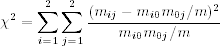
where T is the sample size, m is a properly chosen number of ...
Read now
Unlock full access


 O’Reilly covers everything we've got, with content to help us build a world-class technology community, upgrade the capabilities and competencies of our teams, and improve overall team performance as well as their engagement.I wanted to learn C and C++, but it didn't click for me until I picked up an O'Reilly book. When I went on the O’Reilly platform, I was astonished to find all the books there, plus live events and sandboxes so you could play around with the technology.I’ve been on the O’Reilly platform for more than eight years. I use a couple of learning platforms, but I'm on O'Reilly more than anybody else. When you're there, you start learning. I'm never disappointed.I'm always learning. So when I got on to O'Reilly, I was like a kid in a candy store. There are playlists. There are answers. There's on-demand training. It's worth its weight in gold, in terms of what it allows me to do.