June 2015
Beginner
220 pages
7h 38m
English
Welcome to the BioBuilder program! We are thrilled that you want to bring the tools of synthetic biology into your classroom. Online, we have a variety of materials to help you get started, including some practical lab video tutorials, Microsoft PowerPoint slides, curriculum guides, and lab worksheets. In this written manual, we introduce foundational ideas that underlie synthetic biology, some key aspects of biology that are explored in the field and in the BioBuilder labs, and some helpful information to use as you run the experiments in the BioBuilder program.
In this chapter, we introduce the basic concepts of synthetic biology, explain how it differs from traditional biochemistry and genetic engineering, and begin to explore some of the fundamental engineering principles that will inform how we can solve problems using synthetic biology.
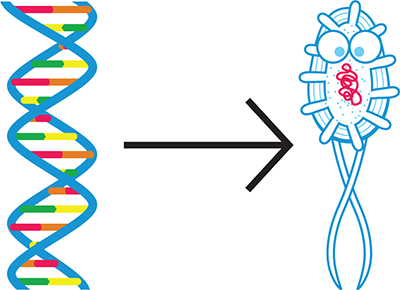
At the most basic level, synthetic biologists, or biobuilders, want to engineer living cells to do something useful; for example, treat a disease, sense a toxic compound in the environment, or produce a valuable drug. As Figure 1-1 suggests, synthetic biologists achieve these outcomes by altering an organism’s DNA so that it behaves “according to specification,” as engineers say—basically, so it does what the biobuilder wants.
Read now
Unlock full access


 O’Reilly covers everything we've got, with content to help us build a world-class technology community, upgrade the capabilities and competencies of our teams, and improve overall team performance as well as their engagement.I wanted to learn C and C++, but it didn't click for me until I picked up an O'Reilly book. When I went on the O’Reilly platform, I was astonished to find all the books there, plus live events and sandboxes so you could play around with the technology.I’ve been on the O’Reilly platform for more than eight years. I use a couple of learning platforms, but I'm on O'Reilly more than anybody else. When you're there, you start learning. I'm never disappointed.I'm always learning. So when I got on to O'Reilly, I was like a kid in a candy store. There are playlists. There are answers. There's on-demand training. It's worth its weight in gold, in terms of what it allows me to do.