March 2020
Beginner
380 pages
9h 44m
English
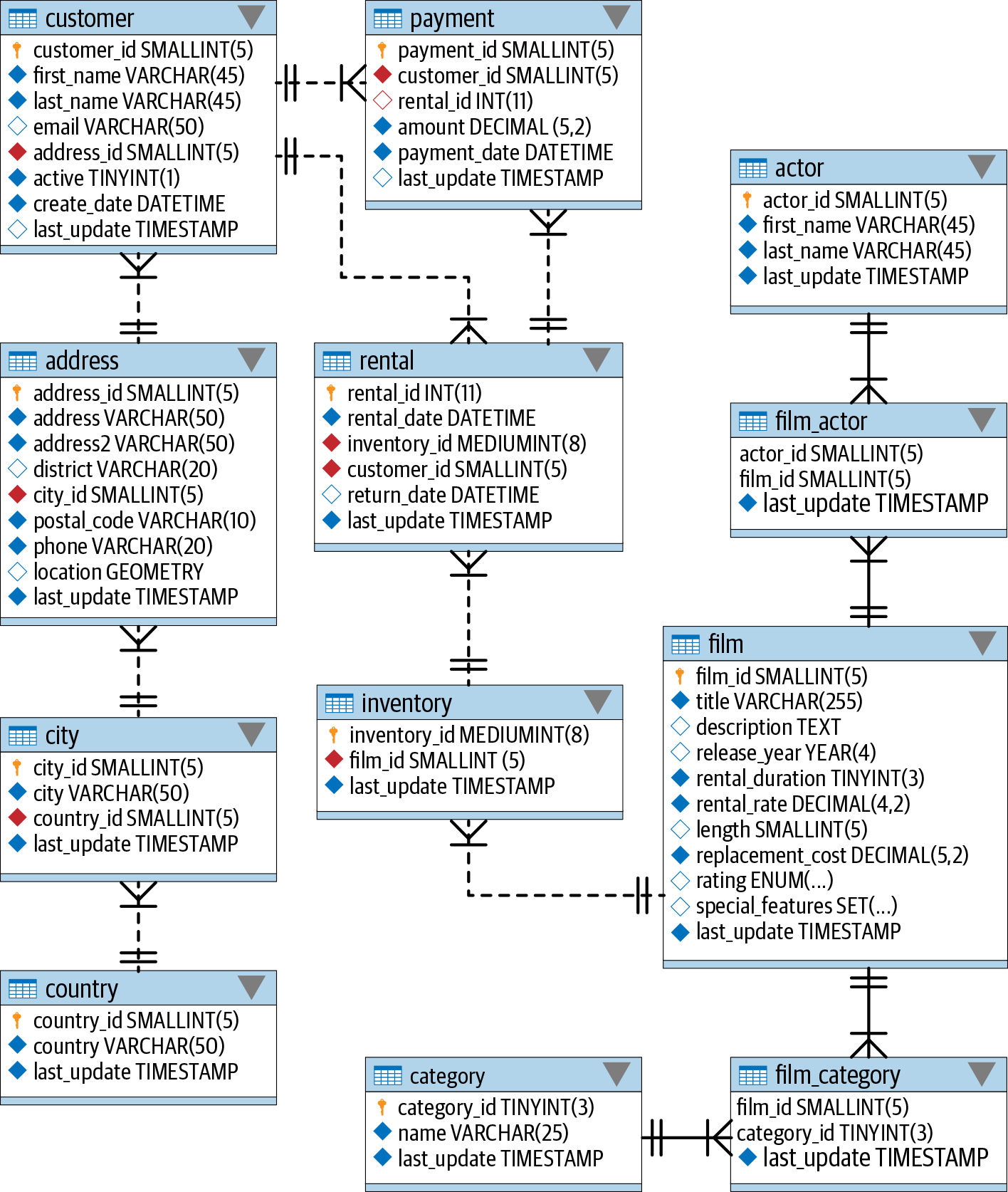
Figure A-1 is an entity-relationship (ER) diagram for the example database used in this book. As the name suggests, the diagram depicts the entities, or tables, in the database along with the foreign-key relationships between the tables. Here are a few tips to help you understand the notation:
Each rectangle represents a table, with the table name above the upper-left corner of the rectangle. The primary-key column(s) are listed first, followed by nonkey columns.
Lines between tables represent foreign key relationships. The markings at either end of the lines represent the allowable quantity, which can be zero (0), one (1), or many (<). For example, if you look at the relationship between the customer and rental tables, you would say that a rental is associated with exactly one customer, but a customer may have zero, one, or many rentals.
For more information on entity-relationship modeling, please see the Wikipedia entry on this topic.
Read now
Unlock full access


 O’Reilly covers everything we've got, with content to help us build a world-class technology community, upgrade the capabilities and competencies of our teams, and improve overall team performance as well as their engagement.I wanted to learn C and C++, but it didn't click for me until I picked up an O'Reilly book. When I went on the O’Reilly platform, I was astonished to find all the books there, plus live events and sandboxes so you could play around with the technology.I’ve been on the O’Reilly platform for more than eight years. I use a couple of learning platforms, but I'm on O'Reilly more than anybody else. When you're there, you start learning. I'm never disappointed.I'm always learning. So when I got on to O'Reilly, I was like a kid in a candy store. There are playlists. There are answers. There's on-demand training. It's worth its weight in gold, in terms of what it allows me to do.