November 2013
Beginner
480 pages
18h 51m
English
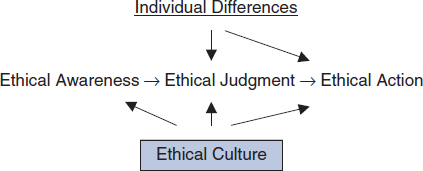
Thus far, we have discussed business ethics primarily in terms of how individual employees think and respond. But anyone who has ever worked knows that employees are not “just” individuals. They become part of something larger; they're members of an organizational culture that affects how they think and behave. Here, we apply this culture concept to organizational ethics. You can think about the ethical culture of an organization as a “slice” of the larger organizational culture that represents the aspects of organizational culture that affect the way employees think and act in ethics-related situations.
In terms of how we've been thinking about ethical decision making, you can consider ethical culture to be a significant organizational influence on individuals' ethical awareness, judgment, and action, along with the individual differences and other influences already discussed in Chapter 3. Recall that most employees are at the conventional level of cognitive moral development, meaning that they are looking outside themselves for guidance about how to think and act. Ethical culture is a source of a good bit of that guidance and can influence employees to be aware of ethical issues (or not), to make good or bad judgments, and to do either the right thing or the wrong thing.
Read now
Unlock full access


 O’Reilly covers everything we've got, with content to help us build a world-class technology community, upgrade the capabilities and competencies of our teams, and improve overall team performance as well as their engagement.I wanted to learn C and C++, but it didn't click for me until I picked up an O'Reilly book. When I went on the O’Reilly platform, I was astonished to find all the books there, plus live events and sandboxes so you could play around with the technology.I’ve been on the O’Reilly platform for more than eight years. I use a couple of learning platforms, but I'm on O'Reilly more than anybody else. When you're there, you start learning. I'm never disappointed.I'm always learning. So when I got on to O'Reilly, I was like a kid in a candy store. There are playlists. There are answers. There's on-demand training. It's worth its weight in gold, in terms of what it allows me to do.