November 2004
Intermediate to advanced
212 pages
5h 2m
English
Most people who write software have at least some experience with unit testing. If you have ever written a few lines of throwaway code just to try something out, you’ve built a unit test. On the other end of the software spectrum, many large-scale applications have huge batteries of test cases that are repeatedly run and added to throughout the development process. Unit tests are useful at all levels of programming.
What are unit test frameworks and how are they used? Simply stated, they are software tools to support writing and running unit tests, including a foundation on which to build tests and the functionality to execute the tests and report their results. They are not solely tools for testing; they can also be used as development tools on a par with preprocessors and debuggers. Unit test frameworks can contribute to almost every stage of software development, including software architecture and design, code implementation and debugging, performance optimization, and quality assurance.
Unit tests usually are developed concurrently with production code, but are not built into the final software product. The relationship of unit tests to production code is shown in Figure 1-1.
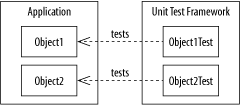 |
An application is built from software objects linked together. The unit tests use the application’s objects, ...
Read now
Unlock full access


 O’Reilly covers everything we've got, with content to help us build a world-class technology community, upgrade the capabilities and competencies of our teams, and improve overall team performance as well as their engagement.I wanted to learn C and C++, but it didn't click for me until I picked up an O'Reilly book. When I went on the O’Reilly platform, I was astonished to find all the books there, plus live events and sandboxes so you could play around with the technology.I’ve been on the O’Reilly platform for more than eight years. I use a couple of learning platforms, but I'm on O'Reilly more than anybody else. When you're there, you start learning. I'm never disappointed.I'm always learning. So when I got on to O'Reilly, I was like a kid in a candy store. There are playlists. There are answers. There's on-demand training. It's worth its weight in gold, in terms of what it allows me to do.