AI engineering: What to know now
The demand for AI engineers is up 143%. Companies need talent that can deploy LLMs, build agents, and ship real GenAI products. Are you up for the challenge? Gain the skills you need to succeed as an AI engineer with trusted content from O’Reilly.
The End of Software Development as We Know It
Programming is a field in transition. Developers are already at work inventing that future, harnessing the power of AI to do things that were previously impossible. Explore new tools, workflows, and hacks that are shaping the emerging discipline of programming with AI.
Start learning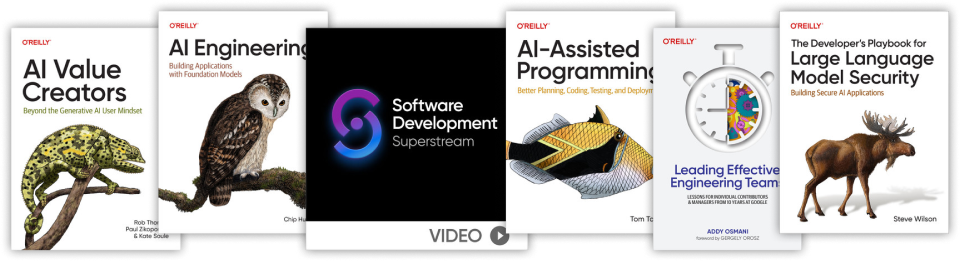
Retrieval-Augmented Generation in Production
Discover the practicalities of meshing RAG with your current systems, get tips on optimizing your information retrieval processes, find out how to overcome common hurdles in production deployment, and much more.
Dive in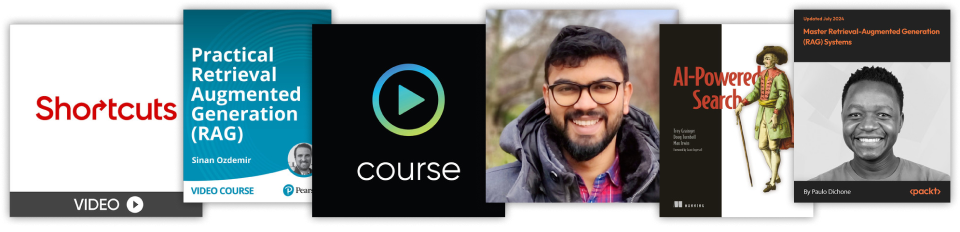
Earn AI engineering certification
Prove you can do the work. Get prepped and then earn the certifications that show you’ve got practical, up-to-date skills.

Niusha Safarpour Doctoral Candidate and Lecturer
Valuable resources

Juan David Orozco Software Test Automation Engineer
Excellent platform to level up tech skills

Andrei Chirinciuc Technical Architect
Best e-learning platform on the market

Anton Semeniuta Senior Business Analyst
The great source of knowledge

Sherilyn Hart IT Manager
Awesome content

Premanand Chandrasekaran Tech Director
Something to accommodate everyone’s learning style!

Daniele Biglia IT Project Manager
A treasure for those who want to grow

James Liu Software Development Engineering Manager
Best learning library hands down

Bethany Greene Professor and Registrar
Great e-learning
Not a member yet?
Get unlimited access to O’Reilly free for 10 days—no credit card required.
Frequently asked questions
What is AI engineering?
AI engineering is the discipline of building applications using readily available foundation models rather than training custom machine learning models from scratch. As Chip Huyen explains in AI Engineering, it’s enabled by the model-as-a-service approach that has transformed AI from an esoteric discipline into a powerful development tool.
What’s the difference between AI engineering and machine learning engineering?
AI engineering and machine learning engineering represent two distinct but related approaches to building intelligent systems, with fundamental differences in methodology, focus, and skill requirements.
AI engineering focuses on building applications using pretrained foundation models like GPT-5, Gemini, Claude, and Llama. Rather than training models from scratch, AI engineers adapt existing models through techniques like prompt engineering, retrieval-augmented generation (RAG), and fine-tuning.
Machine learning engineering, in contrast, traditionally involves the complete machine learning lifecycle, from data collection and feature engineering to model training, validation, and deployment. According to Joe Reis and Matt Housley in Fundamentals of Data Engineering, “ML engineers develop advanced ML techniques, train models, and design and maintain the infrastructure running ML processes in a scaled production environment.”
What skills do I need to become an AI engineer?
AI engineering sits at the intersection of software development and machine learning. You’ll need technical programming skills, familiarity with AI-specific frameworks and tools, and practical engineering capabilities.
Core technical skills:
- Programming with Python—the primary language for AI engineering. Additional proficiency in languages like C++ can be valuable for performance optimization.
- Full stack development, including building complete applications, version control, system design, and cloud deployment on AWS, Azure, or Google Cloud.
- Math fundamentals, including a working knowledge of linear algebra, statistics, and probability, to understand model behavior and evaluate outputs. Deep mathematical expertise becomes more important as you advance but isn’t required to get started.
AI-specific skills:
- Prompt engineering and RAG systems for working with models like ChatGPT
- Model Context Protocol (MCP) for building AI agents that can interact with external tools and data sources
- ML frameworks such as PyTorch, TensorFlow, LangChain, and LlamaIndex
- Data infrastructure and vector databases for retrieval and search systems
In summary, focus on Python and AI fundamentals first. Pick a small project, build with available tools, and progressively tackle harder challenges. The field evolves quickly, so concentrate on developing a strong foundation in programming and math, which will serve you regardless of which AI trends or tools come and go.
Explore the curated resources above to start building these skills today.
What programming languages should AI engineers know?
Python dominates the AI engineering landscape. As Aurélien Géron notes in Hands-On Machine Learning with Scikit-Learn and PyTorch, “Python—the leading language for data science and machine learning”—is the foundation for most AI development work, making it the most essential programming language to learn.
Python’s popularity in AI stems from several key advantages. Wes McKinney explains in the third edition of Python for Data Analysis that “Python’s improved open source libraries (such as pandas and scikit-learn) have made it a popular choice for data analysis tasks. Combined with Python’s overall strength for general-purpose software engineering, it is an excellent option as a primary language for building data applications.”
The language’s ecosystem is particularly rich for AI work. As Géron writes in Hands-On Machine Learning with Scikit-Learn and PyTorch, essential frameworks include:
- scikit-learn: An easy-to-use Python module that lets you implement many machine learning algorithms efficiently
- PyTorch: A powerful and flexible library for deep learning that can distribute computations across multiple GPUs
- TensorFlow and Keras: Production-ready frameworks for neural networks
How do I get started learning AI engineering with O’Reilly?
Start your AI engineering journey with an O’Reilly platform trial—no credit card required. You’ll get instant access to over 60,000 books, 30,000 videos, and hundreds of live online training courses a month from industry experts, including comprehensive AI engineering content from authors like Chip Huyen and Aurélien Géron.
Your 10-day free trial includes:
- Curated AI engineering courses and expert playlists that guide you from foundations to advanced techniques
- Live courses where you can ask questions directly to AI experts
- Mobile and offline access so you can learn anywhere, anytime
The platform is designed for self-paced learning, whether you only have 30 minutes a day or can dedicate full weekends to upskilling. Start with foundational content like Chip Huyen’s AI Engineering to understand the field, then dive into specialized topics like building with LLMs, vector databases, and production deployment strategies.
Start your free trial. No credit card required. Cancel anytime.
What happens after my free trial ends?
After your 10-day free trial ends, your access to the O’Reilly platform will pause automatically—there’s no automatic charge since we don’t collect credit card information up front. You’ll receive an email with subscription options if you’d like to continue. Explore subscription options here.
Can I use O’Reilly for team or company training?
Yes. O’Reilly offers Team and Enterprise subscriptions designed for organizations looking to upskill their technical teams. Enterprise plans include:
- Multi-user licenses with centralized management
- Usage analytics and reporting dashboards
- Custom learning paths aligned to your tech stack
- Integration with your SSO and HRIS systems
- Dedicated customer success support
Team plans start at 2 users and scale to thousands. If you’re evaluating learning platforms for your organization, we’d be happy to arrange a demo and discuss pricing. Contact our enterprise team or compare learning platform options.