December 2002
Intermediate to advanced
192 pages
5h 30m
English
Wireless networking is accomplished by sending and receiving radio waves between a transmitter and receiver. The theory behind RF data transmission can get very complicated and is outside the scope of this book. However, there are some basic concepts you should understand when you implement a WLAN.
A radio wave consists of electromagnetic energy. Visible light, television transmissions, and cosmic radiation are all forms of radio waves. Regardless of the type or purpose of the electromagnetic energy, these waves can be measured by several metrics. The frequency of a radio wave is how often the waveform completes a cycle in a given amount of time. The most common unit of measurement of frequency is the Hertz (Hz). A 1 Hz signal completes one cycle per second while a 10 Hz signal completes 10 cycles per second. Figure 1-1 shows the difference between the waveforms of a 10 Hz signal and a 1 Hz signal.
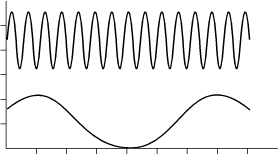
Figure 1-1. A 10 Hz signal (top) and 1 Hz signal (bottom)
Generally, the faster the frequency, the more information you can transmit and receive. The method of encoding (or modulating) the data affects the amount that can be transmitted. Some encoding techniques are more resilient to errors but end up with lower data rates. Conversely, high data rate modulation mechanisms may be more susceptible to outside interference.
In the most general sense, ...
Read now
Unlock full access


 O’Reilly covers everything we've got, with content to help us build a world-class technology community, upgrade the capabilities and competencies of our teams, and improve overall team performance as well as their engagement.I wanted to learn C and C++, but it didn't click for me until I picked up an O'Reilly book. When I went on the O’Reilly platform, I was astonished to find all the books there, plus live events and sandboxes so you could play around with the technology.I’ve been on the O’Reilly platform for more than eight years. I use a couple of learning platforms, but I'm on O'Reilly more than anybody else. When you're there, you start learning. I'm never disappointed.I'm always learning. So when I got on to O'Reilly, I was like a kid in a candy store. There are playlists. There are answers. There's on-demand training. It's worth its weight in gold, in terms of what it allows me to do.