September 2026
Intermediate to advanced
450 pages
11h 50m
English
LLMs such as DeepSeek-R1, OpenAI GPT-5, and Google Gemini are prime examples of how LLMs can be scaled to new heights through reasoning frameworks. Reasoning in LLMs attempts to mimic human thinking by generating thoughts through tokens before giving a final answer. As shown in Figure 3-1, these tokens explain LLMs’ chain-of-thought and allow reasoning LLMs to break down a problem into smaller steps (often called reasoning steps or thought processes).
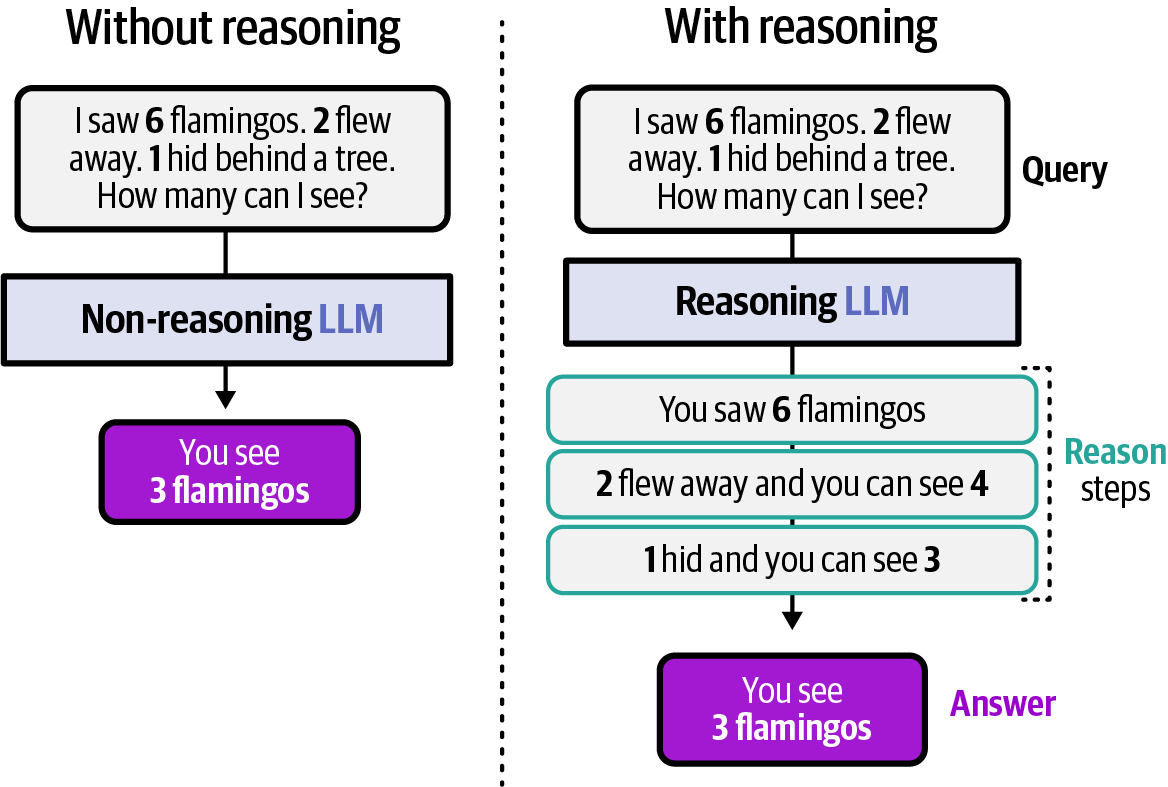
Reasoning LLMs first “think” and generate intermediate information before finally answering the query.
Interestingly, the differences between non-reasoning and reasoning LLMs can be viewed through the lens of human cognition, specifically System 1 and System 2 thinking from Daniel Kahneman’s dual-process theory,1 which describes two modes of human cognition.
System 1, in human cognition, operates automatically and quickly, relying on intuition and learned associations to make snap judgments. Non-reasoning LLMs operate much like System 1 thinking and generate responses quickly based on patterns they learned during training. They produce immediate answers without step-by-step (explicit) thinking.
System 2, in human cognition, engages in slower, more deliberate reasoning that requires conscious effort and attention. Reasoning ...
Read now
Unlock full access


 O’Reilly covers everything we've got, with content to help us build a world-class technology community, upgrade the capabilities and competencies of our teams, and improve overall team performance as well as their engagement.I wanted to learn C and C++, but it didn't click for me until I picked up an O'Reilly book. When I went on the O’Reilly platform, I was astonished to find all the books there, plus live events and sandboxes so you could play around with the technology.I’ve been on the O’Reilly platform for more than eight years. I use a couple of learning platforms, but I'm on O'Reilly more than anybody else. When you're there, you start learning. I'm never disappointed.I'm always learning. So when I got on to O'Reilly, I was like a kid in a candy store. There are playlists. There are answers. There's on-demand training. It's worth its weight in gold, in terms of what it allows me to do.