May 2020
Beginner to intermediate
242 pages
7h 17m
English
We’ve mentioned several times already that we impact our business objectives by making decisions that may or may not have the consequences we expect. But how do we know what to expect? And how did we decide that this set of actions was worth the time spent experimenting in the first place? In this chapter, we will learn one of the most important analytical skills: the ability to simplify the world and solve restricted problems. This will hopefully take us a bit closer to analytical enlightenment.
Revisiting the graphic shown in Figure 5-1, we will now put our focus on the connection between actions and consequences, in a process mediated by causation. This is where we put into practice our outstanding ability to create theories about how the world works. But since the world is complex, we’d better learn how to simplify.
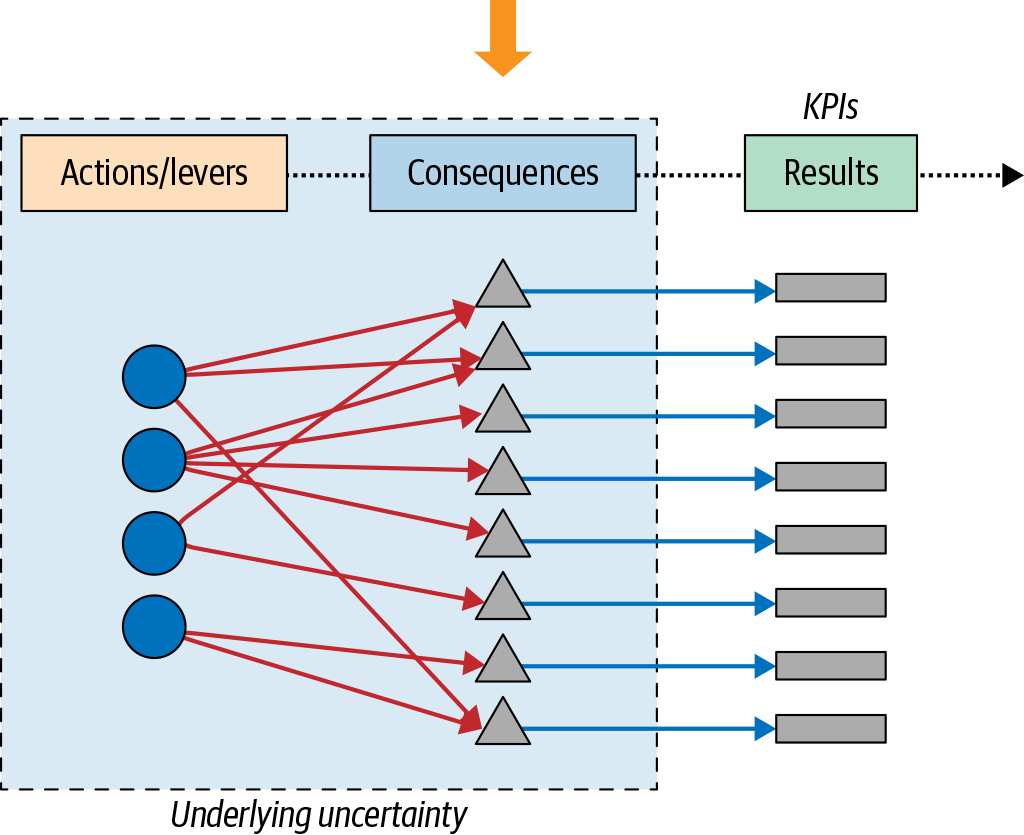
Imagine that we start with a project to solve a new business question. Following the recommendation in Chapter 3, we set up the problem by starting with the question and moving backward. We first identify some drivers behind our objectives and then come up with theories that map our levers to these consequences.
It is not uncommon, however, that for any given consequence we’re going after, there are many levers we can pull. Each ...
Read now
Unlock full access


 O’Reilly covers everything we've got, with content to help us build a world-class technology community, upgrade the capabilities and competencies of our teams, and improve overall team performance as well as their engagement.I wanted to learn C and C++, but it didn't click for me until I picked up an O'Reilly book. When I went on the O’Reilly platform, I was astonished to find all the books there, plus live events and sandboxes so you could play around with the technology.I’ve been on the O’Reilly platform for more than eight years. I use a couple of learning platforms, but I'm on O'Reilly more than anybody else. When you're there, you start learning. I'm never disappointed.I'm always learning. So when I got on to O'Reilly, I was like a kid in a candy store. There are playlists. There are answers. There's on-demand training. It's worth its weight in gold, in terms of what it allows me to do.