January 2005
Beginner to intermediate
350 pages
10h 26m
English
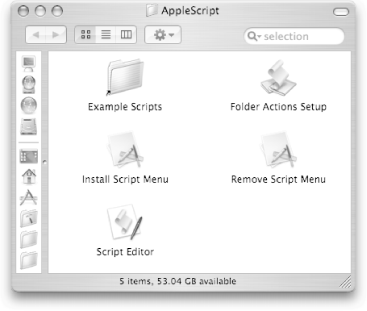
Although AppleScript is fast and free, perhaps the best part about it is that it gets installed right along with Mac OS X. You don’t need to download any files, install any CDs, or configure any nasty system files to get AppleScript to work. In fact, you’ve got an AppleScript folder tucked inside your Applications folder, right this very moment.
 |
If you don’t have this folder, chances are you’re not running Mac OS X Panther. See Section P.4.3.1 for instructions on how to upgrade to the latest version, Mac OS X Panther (version 10.3).
Whenever you install Mac OS X—or buy a new Mac—you’ll find these five icons in your AppleScript folder:
Example Scripts is simply an alias (shortcut) to your Library → Scripts folder. This folder contains more than 100 example scripts for you to run, examine, and edit (Section 1.1.1).
Folder Actions Setup turns on the powerful folder actions feature of OS X. Once it’s on, you can make the Finder run your very own scripts whenever you open a folder, add an icon to a folder, remove an icon from a folder, and so on. (A full explanation of Folder Actions appears on Chapter 11.)
Install Script Menu adds a new icon ...
Read now
Unlock full access


 O’Reilly covers everything we've got, with content to help us build a world-class technology community, upgrade the capabilities and competencies of our teams, and improve overall team performance as well as their engagement.I wanted to learn C and C++, but it didn't click for me until I picked up an O'Reilly book. When I went on the O’Reilly platform, I was astonished to find all the books there, plus live events and sandboxes so you could play around with the technology.I’ve been on the O’Reilly platform for more than eight years. I use a couple of learning platforms, but I'm on O'Reilly more than anybody else. When you're there, you start learning. I'm never disappointed.I'm always learning. So when I got on to O'Reilly, I was like a kid in a candy store. There are playlists. There are answers. There's on-demand training. It's worth its weight in gold, in terms of what it allows me to do.