September 2025
Beginner to intermediate
354 pages
10h 47m
English
Now that your agent has a set of tools that can be used, it’s time to orchestrate them to solve real tasks. Orchestration involves more than just deciding which tools to call and when—it also requires constructing the right context for each model invocation to ensure effective, grounded actions. While simple tasks may only need a single tool and minimal context, more complex workflows demand careful planning, memory retrieval, and dynamic context assembly to perform each step accurately. In this chapter, we’ll cover orchestration strategies, context engineering, tool selection, execution, and planning topologies to build agents capable of handling realistic, multistep tasks efficiently and reliably. As we can see in Figure 5-1, orchestration is how the system utilizes the resources at its disposal to address the user query effectively.
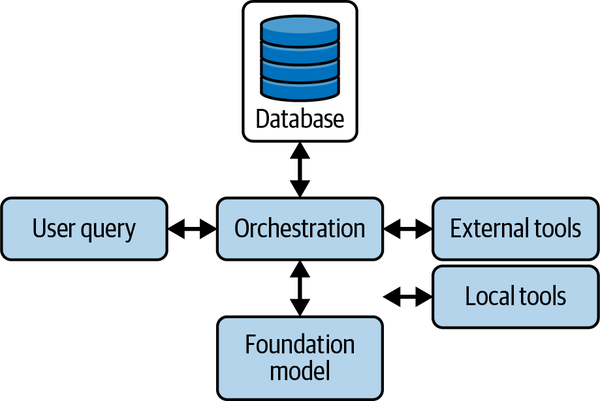
Before diving into specific orchestration strategies, it’s important to understand the different types of agents you can build. Each agent type embodies a distinct approach to reasoning, planning, and action, shaping how tasks are decomposed and executed. Some agents respond instantly with preprogrammed mappings, ...
Read now
Unlock full access


 O’Reilly covers everything we've got, with content to help us build a world-class technology community, upgrade the capabilities and competencies of our teams, and improve overall team performance as well as their engagement.I wanted to learn C and C++, but it didn't click for me until I picked up an O'Reilly book. When I went on the O’Reilly platform, I was astonished to find all the books there, plus live events and sandboxes so you could play around with the technology.I’ve been on the O’Reilly platform for more than eight years. I use a couple of learning platforms, but I'm on O'Reilly more than anybody else. When you're there, you start learning. I'm never disappointed.I'm always learning. So when I got on to O'Reilly, I was like a kid in a candy store. There are playlists. There are answers. There's on-demand training. It's worth its weight in gold, in terms of what it allows me to do.