February 2010
Intermediate to advanced
1043 pages
28h 24m
English
This chapter describes the fundamental types for input and output in .NET, with emphasis on the following topics:
The .NET stream architecture and how it provides a consistent programming interface for reading and writing across a variety of I/O types
Manipulating files and directories on disk
Isolated storage and its role in segregating data by program and user
This chapter concentrates on the types in the System.IO namespace, the home of lower-level I/O functionality. The .NET
Framework also provides higher-level I/O functionality in the form of SQL
connections and commands, LINQ to SQL and
LINQ to XML, Windows Communication Foundation, Web Services, and
Remoting.
The .NET stream architecture centers on three concepts: backing stores, decorators, and adapters, as shown in Figure 14-1.
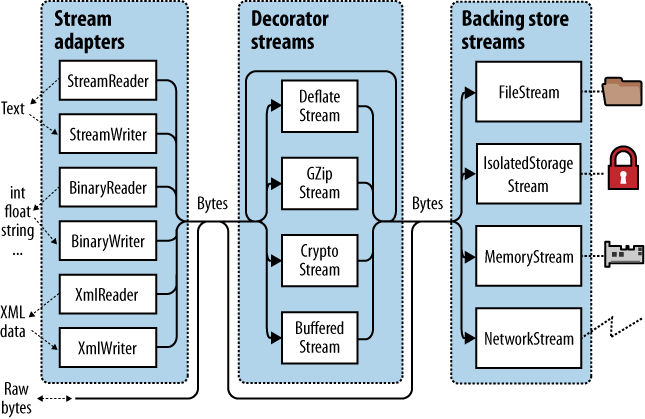
Figure 14-1. Stream architecture
A backing store is the endpoint that makes input and output useful, such as a file or network connection. Precisely, it is either or both of the following:
A source from which bytes can be sequentially read
A destination to which bytes can be sequentially written
A backing store is of no use, though, unless exposed to the
programmer. A Stream is the standard .NET class for this purpose; it exposes a standard set of methods for reading, writing, and positioning. Unlike an array, where all the backing data exists in memory at once, ...
Read now
Unlock full access


 O’Reilly covers everything we've got, with content to help us build a world-class technology community, upgrade the capabilities and competencies of our teams, and improve overall team performance as well as their engagement.I wanted to learn C and C++, but it didn't click for me until I picked up an O'Reilly book. When I went on the O’Reilly platform, I was astonished to find all the books there, plus live events and sandboxes so you could play around with the technology.I’ve been on the O’Reilly platform for more than eight years. I use a couple of learning platforms, but I'm on O'Reilly more than anybody else. When you're there, you start learning. I'm never disappointed.I'm always learning. So when I got on to O'Reilly, I was like a kid in a candy store. There are playlists. There are answers. There's on-demand training. It's worth its weight in gold, in terms of what it allows me to do.