September 2012
Beginner to intermediate
384 pages
10h 52m
English
Chapter 9: Color Constancy Using Low-level Features
The first type of illuminant estimation algorithms discussed in this book are static methods, or methods that are applied to input images with a fixed parameter setting. Two subtypes are distinguished: a) methods that are based on low-level statistics and b) methods that are based on the physics-based dichromatic reflection model.
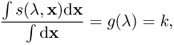
The best-known and most often used assumption of this type is the gray-world assumption [137]: the average reflectance in a scene under a neutral light source is achromatic. In the original work, the hypothesis is used to derive that the average reflectance for short-wave, middle-wave and long-wave regions is equal, but a stronger definition of achromatic reflectance of a scene is often employed ([139, 138]):
which avoids making further assumptions. 1The constant k is between 0 for no reflectance (black) and 1 for total reflectance (white) of the incident light, and the integral is over the domain of the scene. For such a scene with achromatic reflectance, it holds that the reflected color is equal to the color of the light source, since
9.2 
9.3 
9.4
where the theorem of Fubini ...
Read now
Unlock full access


 O’Reilly covers everything we've got, with content to help us build a world-class technology community, upgrade the capabilities and competencies of our teams, and improve overall team performance as well as their engagement.I wanted to learn C and C++, but it didn't click for me until I picked up an O'Reilly book. When I went on the O’Reilly platform, I was astonished to find all the books there, plus live events and sandboxes so you could play around with the technology.I’ve been on the O’Reilly platform for more than eight years. I use a couple of learning platforms, but I'm on O'Reilly more than anybody else. When you're there, you start learning. I'm never disappointed.I'm always learning. So when I got on to O'Reilly, I was like a kid in a candy store. There are playlists. There are answers. There's on-demand training. It's worth its weight in gold, in terms of what it allows me to do.