September 2025
Intermediate to advanced
384 pages
11h 34m
English
The more privilege you have, the more opportunity you have. The more opportunity you have, the more responsibility you have.
Noam Chomsky
In Chapter 1, we introduced the lakehouse paradigm and explained how Databricks Platform stores the data in the cloud object storage and provides an optimization layer for efficient querying and ACID properties. In Chapter 3, we explored identity management concepts and touched upon access management. In this chapter, we describe how Unity Catalog secures the data and AI assets, various access control mechanisms, permissions models, and how you can design a scalable data architecture. We also discuss different governance models and how our fictional organization Nexa Boutique leveraged Unity Catalog to design a federated governance model with centralized policies.
Chapter 3 briefly mentioned workspace and Unity Catalog securables. The access controls for workspace securables are applied at the workspace level, and the access controls for Unity Catalog securables are applied at the Unity Catalog metastore level. This is depicted in Figure 5-1.
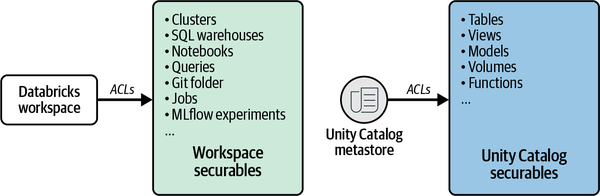
From the access management perspective, you can think of a Databricks workspace as a combination of project and compute layers. The workspace securables ...
Read now
Unlock full access


 O’Reilly covers everything we've got, with content to help us build a world-class technology community, upgrade the capabilities and competencies of our teams, and improve overall team performance as well as their engagement.I wanted to learn C and C++, but it didn't click for me until I picked up an O'Reilly book. When I went on the O’Reilly platform, I was astonished to find all the books there, plus live events and sandboxes so you could play around with the technology.I’ve been on the O’Reilly platform for more than eight years. I use a couple of learning platforms, but I'm on O'Reilly more than anybody else. When you're there, you start learning. I'm never disappointed.I'm always learning. So when I got on to O'Reilly, I was like a kid in a candy store. There are playlists. There are answers. There's on-demand training. It's worth its weight in gold, in terms of what it allows me to do.