July 2016
Intermediate to advanced
35 pages
1h 3m
English
There is no serious enterprise-grade application without persistent data. And the same is true for microservices-based applications. Event sourcing and CQRS are fundamental concepts behind Lagom’s support for services that store information. To understand these concepts, it is recommended that you read Lagom’s CQRS and Event Sourcing documentation.
When using event sourcing, all changes are captured as domain events, which are immutable facts of things that have happened. The persistent equivalent is called an AggregateRoot (PersistentEntity). This is a cluster of domain objects that can be treated as a single unit. An example may be a piece of cargo and its transport legs, which will be separate objects, but it’s useful to treat the cargo (together with its transport legs) as a single aggregate. The aggregate can reply to queries for a specific identifier but it cannot be used for serving queries that span more than one aggregate. Therefore, you need to create another view of the data that is tailored to the queries that the service provides (see Figure 4-1). This separation of the write-side and the read-side of the persistent data is often referred to as the CQRS pattern.
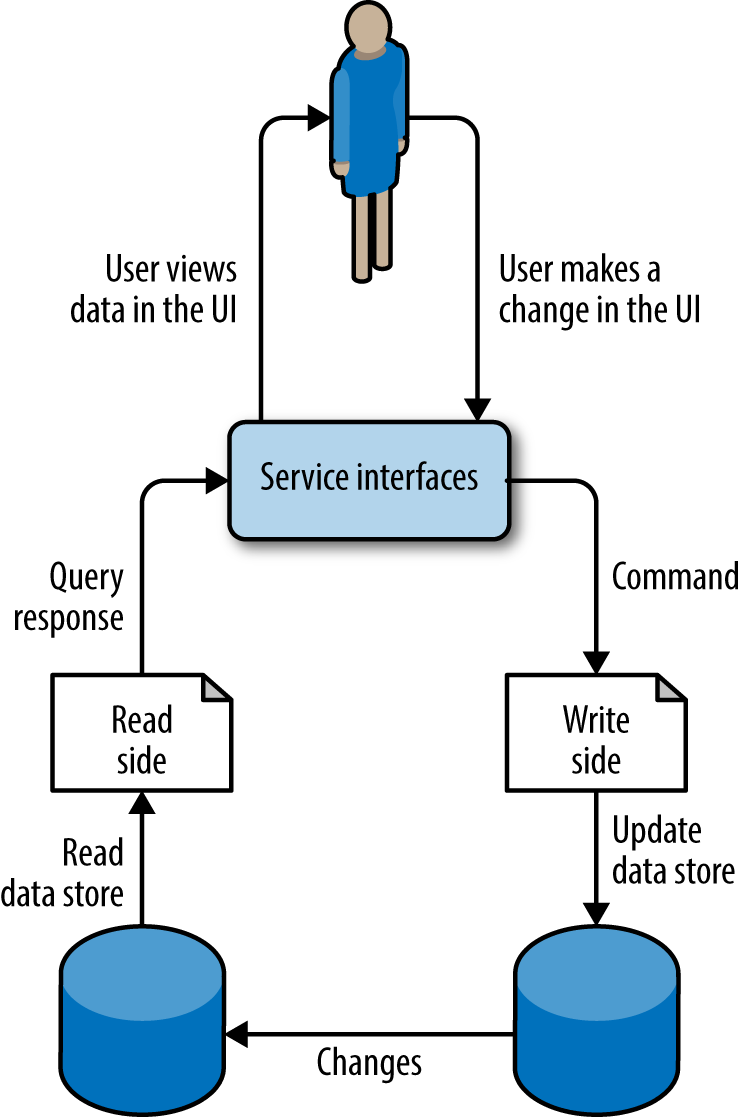
To implement persistence in Lagom you have to implement a class that extends PersistentEntity<Command, ...
Read now
Unlock full access


 O’Reilly covers everything we've got, with content to help us build a world-class technology community, upgrade the capabilities and competencies of our teams, and improve overall team performance as well as their engagement.I wanted to learn C and C++, but it didn't click for me until I picked up an O'Reilly book. When I went on the O’Reilly platform, I was astonished to find all the books there, plus live events and sandboxes so you could play around with the technology.I’ve been on the O’Reilly platform for more than eight years. I use a couple of learning platforms, but I'm on O'Reilly more than anybody else. When you're there, you start learning. I'm never disappointed.I'm always learning. So when I got on to O'Reilly, I was like a kid in a candy store. There are playlists. There are answers. There's on-demand training. It's worth its weight in gold, in terms of what it allows me to do.