June 2004
Beginner to intermediate
364 pages
7h 38m
English
This chapter is about mastering Eclipse in everyday use. Chapter 1 gave you the basics; this chapter is designed to give you a working knowledge.
As with any complex tool, you might want to change things about Eclipse as you work with it more and more. So, in addition to teaching you how to work with Eclipse, this chapter also teaches you the many ways in which you can customize Eclipse, from moving views to creating your own perspectives.
When it comes to customizing Eclipse, one dialog stands out over the rest: the Preferences dialog, which you open by selecting Window→ Preferences. This dialog is shown in Figure 2-1.
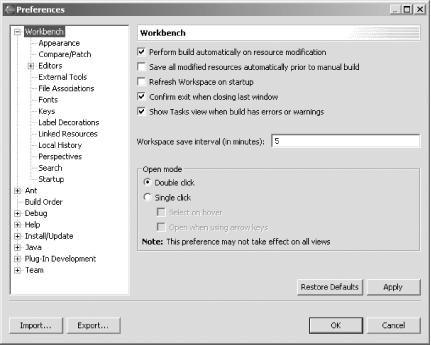
Figure 2-1. The Preferences dialog
I encourage you to become familiar with this dialog. The Preferences dialog is the home of Eclipse customization, especially workbench customization. Want to automatically close all editors when you exit Eclipse (which enables Eclipse to start more quickly next time)? Select Window→ Preferences→ Workbench→ Editors and then check the “Close all editors on exit” checkbox. Want to make editor tabs appear on the bottom of editor windows? Select Window→ Preferences→ Workbench→ Appearance, and click Bottom in the Editor tab position box. Want to specify what editor or program Eclipse should use to open files with a certain file extension? Select Window→ Preferences→ Workbench→ File Associations, choose a ...
Read now
Unlock full access


 O’Reilly covers everything we've got, with content to help us build a world-class technology community, upgrade the capabilities and competencies of our teams, and improve overall team performance as well as their engagement.I wanted to learn C and C++, but it didn't click for me until I picked up an O'Reilly book. When I went on the O’Reilly platform, I was astonished to find all the books there, plus live events and sandboxes so you could play around with the technology.I’ve been on the O’Reilly platform for more than eight years. I use a couple of learning platforms, but I'm on O'Reilly more than anybody else. When you're there, you start learning. I'm never disappointed.I'm always learning. So when I got on to O'Reilly, I was like a kid in a candy store. There are playlists. There are answers. There's on-demand training. It's worth its weight in gold, in terms of what it allows me to do.