October 2025
Intermediate to advanced
508 pages
13h 45m
English
Foundational models are closed systems that are limited by their training data. In many cases, you’ll need to give a foundational model additional information. For example, the information may be based on recent events that had not occurred when the foundational model was being trained, or the information may have been private, confidential, or otherwise unavailable to the foundational model trainers.
It’s impractical to retrain an LLM with additional knowledge or even perform continuing pretraining (CPT) on a foundational model to add knowledge to it. The cost of even a single training run is significant, and information changes so fast that CPT would have to be done very frequently. These costs can add up to tens of millions of dollars,1 so you’ll typically want to use a foundational model as is and add knowledge to it at runtime.
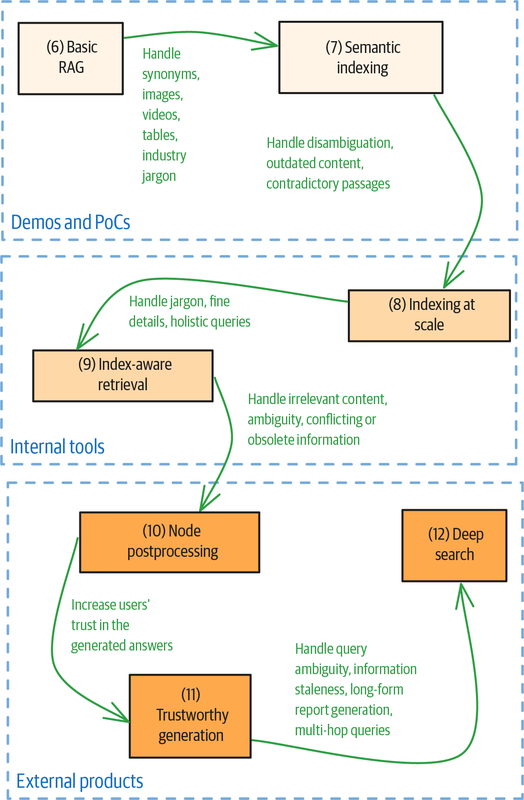
The key pattern that’s used to provide additional information to a foundational model at runtime was introduced in the landmark paper “Retrieval-Augmented Generation for Knowledge-Intensive NLP Tasks” in 2020 by researchers working at Facebook AI Research (which is now part of Meta). Retrieval-augmented generation (RAG) transforms foundational models from closed systems that are limited by their training data into open systems that can leverage external knowledge on demand.
Read now
Unlock full access


 O’Reilly covers everything we've got, with content to help us build a world-class technology community, upgrade the capabilities and competencies of our teams, and improve overall team performance as well as their engagement.I wanted to learn C and C++, but it didn't click for me until I picked up an O'Reilly book. When I went on the O’Reilly platform, I was astonished to find all the books there, plus live events and sandboxes so you could play around with the technology.I’ve been on the O’Reilly platform for more than eight years. I use a couple of learning platforms, but I'm on O'Reilly more than anybody else. When you're there, you start learning. I'm never disappointed.I'm always learning. So when I got on to O'Reilly, I was like a kid in a candy store. There are playlists. There are answers. There's on-demand training. It's worth its weight in gold, in terms of what it allows me to do.