May 2024
Intermediate to advanced
362 pages
8h 47m
English
In this chapter, you will learn about data transformations and how they will help you convert a non-private data analysis into a differentially private data analysis. Understanding if a data transformation is stable will help you identify whether your data analysis can be transformed into a DP data analysis.
Data transformations encompass any function from a data set to a data set. In the context of transformations, consider a data set to be any form of data that has not been made private. Transformations are mathematical abstractions that represent any manipulations, modifications, and computations performed on a data set.
Non-private data analysis pipelines can typically be broken down into three distinct phases: data preprocessing, a statistical query, and postprocessing. In the pipeline shown in Figure 3-1, data passes sequentially through each phase.
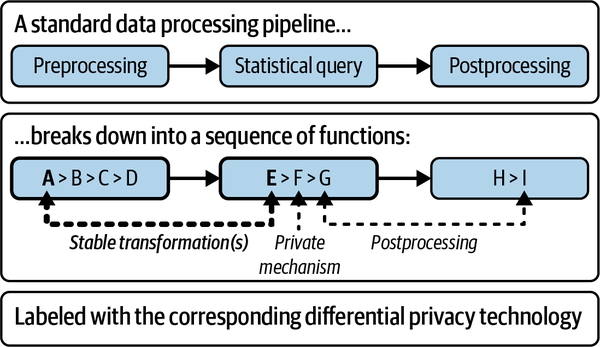
In a non-DP context, preprocessing consists of any modifications you may make to microdata. Microdata is a data set where each row corresponds to data from one individual.
An example is a function that modifies each record in a data set, one at a time, while preserving the dimensions of the data. Consider a preprocessing that doubles the value of each numeric element in a column. In differential privacy, ...
Read now
Unlock full access


 O’Reilly covers everything we've got, with content to help us build a world-class technology community, upgrade the capabilities and competencies of our teams, and improve overall team performance as well as their engagement.I wanted to learn C and C++, but it didn't click for me until I picked up an O'Reilly book. When I went on the O’Reilly platform, I was astonished to find all the books there, plus live events and sandboxes so you could play around with the technology.I’ve been on the O’Reilly platform for more than eight years. I use a couple of learning platforms, but I'm on O'Reilly more than anybody else. When you're there, you start learning. I'm never disappointed.I'm always learning. So when I got on to O'Reilly, I was like a kid in a candy store. There are playlists. There are answers. There's on-demand training. It's worth its weight in gold, in terms of what it allows me to do.