September 2026
Beginner to intermediate
500 pages
12h 27m
English
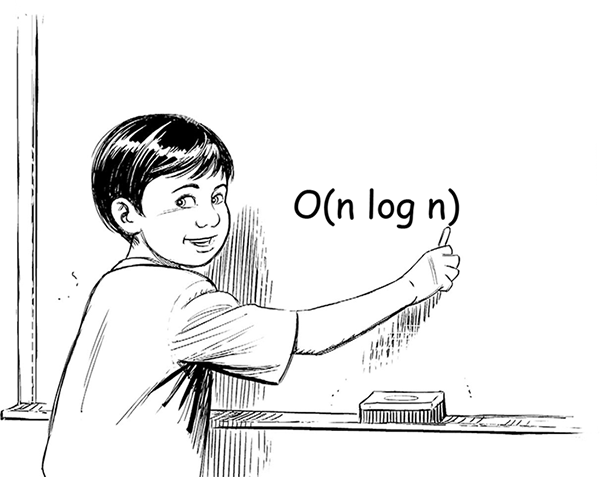
Your search is fast now. But the real question is, will it stay fast as the input data doubles? Or triples? Or grows to a million?
One way that helps us think about this is the algorithms’ growth curve. Some seem to climb gently, while others explode upward. But how do we actually talk about those curves? We need a vocabulary. How do we describe the difference between an algorithm that scales well as input grows, and one that gets you into trouble?
That’s where Big O comes in. Big O doesn’t care about your processor or your RAM. It cares about how your algorithm behaves, especially when your algorithm is under pressure.
In this chapter, we’ll get comfortable with Big O: how to read it, how to write it, and (yes) how to actually understand it. You won’t need to understand dense formulas (just the opposite) and no math degree is required.
The payoff? Learning how to describe the efficiency ...
Read now
Unlock full access


 O’Reilly covers everything we've got, with content to help us build a world-class technology community, upgrade the capabilities and competencies of our teams, and improve overall team performance as well as their engagement.I wanted to learn C and C++, but it didn't click for me until I picked up an O'Reilly book. When I went on the O’Reilly platform, I was astonished to find all the books there, plus live events and sandboxes so you could play around with the technology.I’ve been on the O’Reilly platform for more than eight years. I use a couple of learning platforms, but I'm on O'Reilly more than anybody else. When you're there, you start learning. I'm never disappointed.I'm always learning. So when I got on to O'Reilly, I was like a kid in a candy store. There are playlists. There are answers. There's on-demand training. It's worth its weight in gold, in terms of what it allows me to do.