July 2005
Beginner
268 pages
7h 41m
English
To take a look at your Keychain, open the Keychain Access program as described in the previous section. When you click one of the password rows, you get to see its attributes—the name, the kind, the account, and so on (Figure A-1). At this point, if you're running Mac OS X, you can turn on "Show password" to see the actual password that's stored safely here in the Keychain. In Mac OS 9, select the name of the Keychain item and press the Get Info button. Then, from the dialog box, click View Password.
You can also click the Access Control tab, which gives you even more control over the security settings (see Figure A-2).
The primary purpose of the Keychain is, of course, to type in passwords for you automatically. However, it's also an excellent place to record all kinds of private information just for your own reference: credit card numbers, ATM numbers, and so on. Just click the Access Control tab, then click the Add button.
No, the Mac won't type them in for you automatically anywhere, but it does maintain them in one central location that is, itself, password protected.
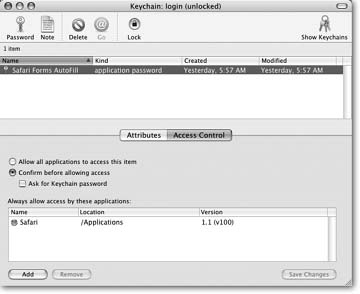
Figure A-2. This panel lists the programs that are allowed to "see" this password—yet another degree of security. The "Confirm before allowing access" checkbox gives you another layer of protection. If you turn on the checkbox here, Mac OS X asks you for permission ...
Read now
Unlock full access


 O’Reilly covers everything we've got, with content to help us build a world-class technology community, upgrade the capabilities and competencies of our teams, and improve overall team performance as well as their engagement.I wanted to learn C and C++, but it didn't click for me until I picked up an O'Reilly book. When I went on the O’Reilly platform, I was astonished to find all the books there, plus live events and sandboxes so you could play around with the technology.I’ve been on the O’Reilly platform for more than eight years. I use a couple of learning platforms, but I'm on O'Reilly more than anybody else. When you're there, you start learning. I'm never disappointed.I'm always learning. So when I got on to O'Reilly, I was like a kid in a candy store. There are playlists. There are answers. There's on-demand training. It's worth its weight in gold, in terms of what it allows me to do.