May 2011
Beginner to intermediate
258 pages
5h 20m
English
A Quick Overview of CSS
CSS works by describing certain parts of the page (one particular tag, all the tags of a specific type, or all tags sharing a particular characteristic). For each of these tag groups, you can then identify a number of rules. Each rule is a name/value pair. Take a look at the simple page displayed in Figure 5-1.
Figure 5-1
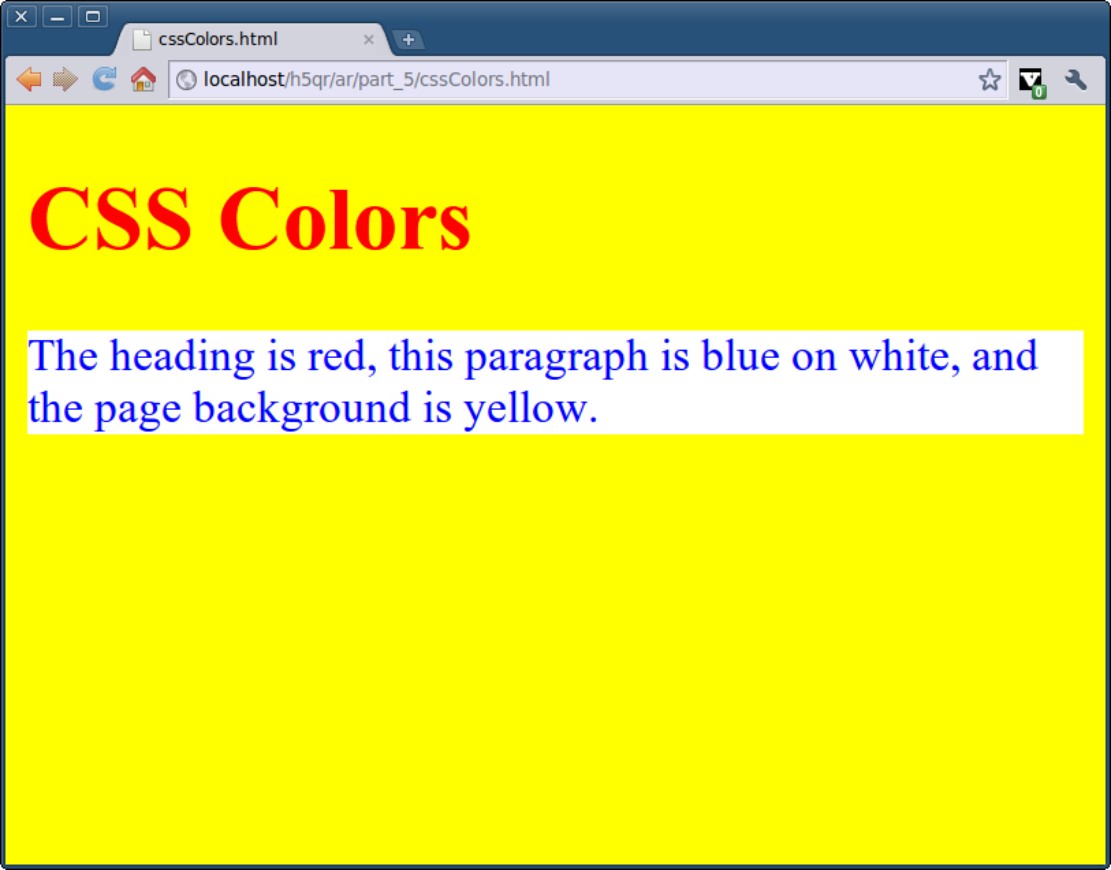
The code to produce this page is shown here:
<!DOCTYPE HTML>
<html lang = “en”>
<head>
<title>cssColors.html</title>
<meta charset = ”UTF-8” />
<style type = ”text/css”>
body {
background-color: yellow;
}
h1 {
color: red;
}
p {
color: blue;
background-color: white;
}
</style>
</head>
<body>
<h1>CSS Colors</h1>
<p>
The heading is red, this paragraph is blue on white, and the page background is yellow.
</p>
</body>
</html>
 It goes without saying that a page about colors is disappointing to view in a black-and-white book. As always, be sure to look on the book’s companion Web page (www.aharrisbooks.net/h5qr) to see this page in full and try it on your own machine.
The new elements are not terribly surprising, but they are quite powerful. Note that the colors are changed without changing anything in the HTML body. All the real action happens in a special part of ...
Read now
Unlock full access


 O’Reilly covers everything we've got, with content to help us build a world-class technology community, upgrade the capabilities and competencies of our teams, and improve overall team performance as well as their engagement.I wanted to learn C and C++, but it didn't click for me until I picked up an O'Reilly book. When I went on the O’Reilly platform, I was astonished to find all the books there, plus live events and sandboxes so you could play around with the technology.I’ve been on the O’Reilly platform for more than eight years. I use a couple of learning platforms, but I'm on O'Reilly more than anybody else. When you're there, you start learning. I'm never disappointed.I'm always learning. So when I got on to O'Reilly, I was like a kid in a candy store. There are playlists. There are answers. There's on-demand training. It's worth its weight in gold, in terms of what it allows me to do.