September 2002
Intermediate to advanced
656 pages
22h 14m
English
Now that we’ve sketched what HTTP’s messages look like, let’s talk for a moment about how messages move from place to place, across Transmission Control Protocol (TCP) connections.
HTTP is an application layer protocol. HTTP doesn’t worry about the nitty-gritty details of network communication; instead, it leaves the details of networking to TCP/IP, the popular reliable Internet transport protocol.
TCP provides:
Error-free data transportation
In-order delivery (data will always arrive in the order in which it was sent)
Unsegmented data stream (can dribble out data in any size at any time)
The Internet itself is based on TCP/IP, a popular layered set of packet-switched network protocols spoken by computers and network devices around the world. TCP/IP hides the peculiarities and foibles of individual networks and hardware, letting computers and networks of any type talk together reliably.
Once a TCP connection is established, messages exchanged between the client and server computers will never be lost, damaged, or received out of order.
In networking terms, the HTTP protocol is layered over TCP. HTTP uses TCP to transport its message data. Likewise, TCP is layered over IP (see Figure 1-9).
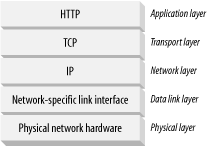
Figure 1-9. HTTP network protocol stack
Before an HTTP client can send a message to a server, it needs to establish a TCP/IP connection between ...
Read now
Unlock full access


 O’Reilly covers everything we've got, with content to help us build a world-class technology community, upgrade the capabilities and competencies of our teams, and improve overall team performance as well as their engagement.I wanted to learn C and C++, but it didn't click for me until I picked up an O'Reilly book. When I went on the O’Reilly platform, I was astonished to find all the books there, plus live events and sandboxes so you could play around with the technology.I’ve been on the O’Reilly platform for more than eight years. I use a couple of learning platforms, but I'm on O'Reilly more than anybody else. When you're there, you start learning. I'm never disappointed.I'm always learning. So when I got on to O'Reilly, I was like a kid in a candy store. There are playlists. There are answers. There's on-demand training. It's worth its weight in gold, in terms of what it allows me to do.