October 2006
Intermediate to advanced
284 pages
8h 30m
English
The interface Collection (see Figure 12-1) defines the core functionality that we expect of
any collection other than a map. It provides methods in four
groups.
Adding Elements
boolean add(E e)                           // add the element e
boolean addAll(Collection<? extends E> c)  // add the contents of c
The boolean result returned by these methods indicates whether the
collection was changed by the call. It can be false for collections, such as
sets, which will be unchanged if they are asked to add an element that is
already present. But the method contracts specify that the elements being
added must be present after execution so, if the collection refuses an
element for any other reason (for example, some collections don’t permit
null elements), these methods must throw
an exception.
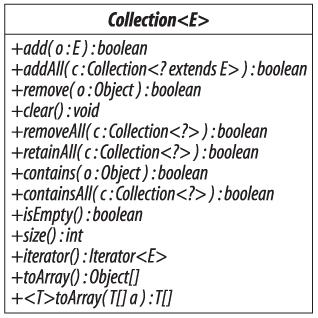
The signatures of these methods show that, as you might expect, you can add elements or element collections only of the parametric type.
Removing Elements
boolean remove(Object o)            // remove the element o
void clear()                        // remove all elements
boolean removeAll(Collection<?> c)  // remove the elements in c
boolean retainAll(Collection<?> c)  // remove the elements *not* in c
If the element 0 is null, remove
removes a null from the collection if one is present. Otherwise, if an element
e is present for which 0.equals(e), it removes it. If not, it leaves the
collection unchanged. ...
Read now
Unlock full access


 O’Reilly covers everything we've got, with content to help us build a world-class technology community, upgrade the capabilities and competencies of our teams, and improve overall team performance as well as their engagement.I wanted to learn C and C++, but it didn't click for me until I picked up an O'Reilly book. When I went on the O’Reilly platform, I was astonished to find all the books there, plus live events and sandboxes so you could play around with the technology.I’ve been on the O’Reilly platform for more than eight years. I use a couple of learning platforms, but I'm on O'Reilly more than anybody else. When you're there, you start learning. I'm never disappointed.I'm always learning. So when I got on to O'Reilly, I was like a kid in a candy store. There are playlists. There are answers. There's on-demand training. It's worth its weight in gold, in terms of what it allows me to do.