July 2019
Intermediate to advanced
391 pages
8h 40m
English
We have already explored some of the common and built-in patterns in OpenWhisk, which are useful for implementing single actions. In this chapter, we’ll explore patterns that are useful for integrating different actions and interacting with users. We continue the implementation of some classical “Gang of Four” design patterns and also cover the ubiquitous Model-View-Controller pattern implemented for OpenWhisk.
In Figure 5-1 we can see the patterns covered in this chapter and the previous chapter:
Singleton
Facade
Prototype
Strategy
Chain of Responsibility
Command
Bridge
Proxy
Adapter
Observer
Composite and Visitor
MVC
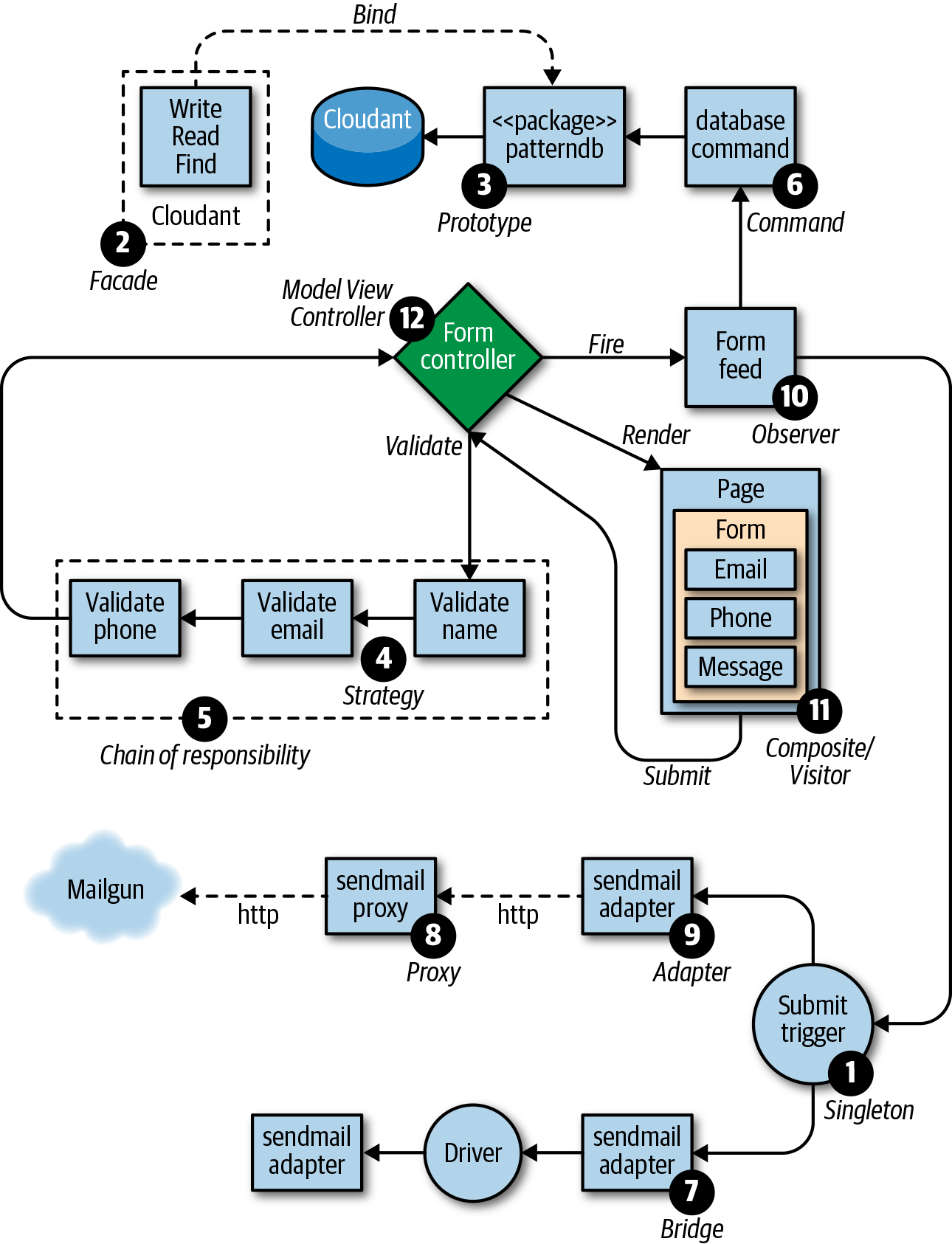
The source code for the examples of the design patterns (this chapter and the previous chapter) are available in the GitHub repository.
In this section we discuss the patterns commonly used to connect different systems. These include:
Used when you want to keep the same interface to a system but change the details at the implementation level
Used for adapting requests from one interface to a system to another.
Used when you want to define a common generic interface to a class of systems and then specify different implementations for each case
Used when you ...
Read now
Unlock full access


 O’Reilly covers everything we've got, with content to help us build a world-class technology community, upgrade the capabilities and competencies of our teams, and improve overall team performance as well as their engagement.I wanted to learn C and C++, but it didn't click for me until I picked up an O'Reilly book. When I went on the O’Reilly platform, I was astonished to find all the books there, plus live events and sandboxes so you could play around with the technology.I’ve been on the O’Reilly platform for more than eight years. I use a couple of learning platforms, but I'm on O'Reilly more than anybody else. When you're there, you start learning. I'm never disappointed.I'm always learning. So when I got on to O'Reilly, I was like a kid in a candy store. There are playlists. There are answers. There's on-demand training. It's worth its weight in gold, in terms of what it allows me to do.