August 2012
Beginner
583 pages
16h 1m
English
MySQL is called a relational database management system because its tables store not only data, but the relationships among the data. There are three categories of these relationships.
A one-to-one relationship between two types of data is like a (traditional) marriage: each item has a relationship to only one item of the other type. This is surprisingly rare. For instance, an author can write multiple books, a book can have multiple authors, and even an address can be associated with multiple customers. Perhaps the best example in this chapter so far of a one-to-one relationship is the relationship between the name of a state and its two-character abbreviation.
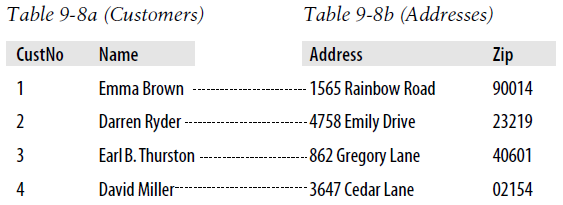
However, for the sake of argument, let’s assume that there can
only ever be one customer at any given address. In such a case, the
Customers-Addresses relationship in
Figure 9-1 is a
one-to-one relationship: only one customer lives at each address and
each address can have only one customer.
Usually, when two items have a one-to-one relationship, you just include them as columns in the same table. There are two reasons for splitting them into separate tables:
You want to be prepared in case the relationship changes later.
The table has a lot of columns and you think that performance or maintenance would be improved by splitting it.
Of course, ...
Read now
Unlock full access


 O’Reilly covers everything we've got, with content to help us build a world-class technology community, upgrade the capabilities and competencies of our teams, and improve overall team performance as well as their engagement.I wanted to learn C and C++, but it didn't click for me until I picked up an O'Reilly book. When I went on the O’Reilly platform, I was astonished to find all the books there, plus live events and sandboxes so you could play around with the technology.I’ve been on the O’Reilly platform for more than eight years. I use a couple of learning platforms, but I'm on O'Reilly more than anybody else. When you're there, you start learning. I'm never disappointed.I'm always learning. So when I got on to O'Reilly, I was like a kid in a candy store. There are playlists. There are answers. There's on-demand training. It's worth its weight in gold, in terms of what it allows me to do.