April 2006
Beginner to intermediate
283 pages
7h 44m
English
When designing a software system, it’s rare to jump directly from requirements to defining the classes in your system. With all but the most trivial systems, it’s helpful to plan out the high-level pieces of your system to establish the architecture and manage complexity and dependencies among the parts. Components are used to organize a system into manageable, reusable, and swappable pieces of software.
UML component diagrams model the components in your system and as such form part of the development view , as shown in Figure 12-1. The development view describes how your system’s parts are organized into modules and components and is great at helping you manage layers within your system’s architecture.
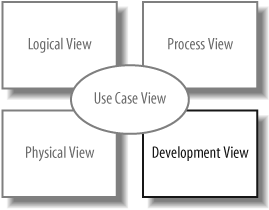
A component is an encapsulated, reusable, and replaceable part of your software. You can think of components as building blocks: you combine them to fit together (possibly building successively larger components) to form your software. Because of this, components can range in size from relatively small, about the size of a class, up to a large subsystem.
Good candidates for components are items that perform a key functionality and will be used frequently throughout your system. ...
Read now
Unlock full access


 O’Reilly covers everything we've got, with content to help us build a world-class technology community, upgrade the capabilities and competencies of our teams, and improve overall team performance as well as their engagement.I wanted to learn C and C++, but it didn't click for me until I picked up an O'Reilly book. When I went on the O’Reilly platform, I was astonished to find all the books there, plus live events and sandboxes so you could play around with the technology.I’ve been on the O’Reilly platform for more than eight years. I use a couple of learning platforms, but I'm on O'Reilly more than anybody else. When you're there, you start learning. I'm never disappointed.I'm always learning. So when I got on to O'Reilly, I was like a kid in a candy store. There are playlists. There are answers. There's on-demand training. It's worth its weight in gold, in terms of what it allows me to do.