August 2021
Intermediate to advanced
542 pages
11h 16m
English
Every time you start your Linux computer, its initialization system launches a batch of processes, from a few dozen to hundreds, depending on how the system is set up. You can see this on your startup screen (Figure 4-1; press the Escape key to hide your graphical startup screen and see the startup messages).
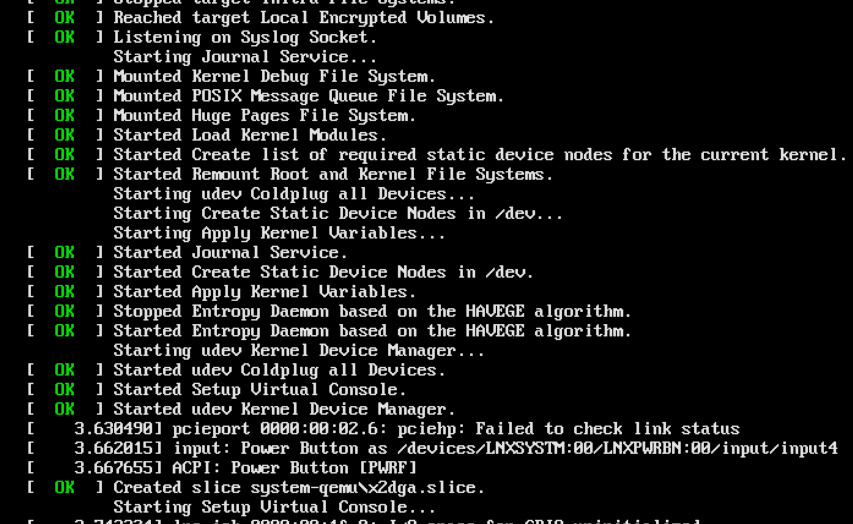
In olden times we had the Unix System V initialization system (SysV init), BSD init, and Linux Standard Base (LSB) init for launching processes at startup. SysV init was the most common. Those days are fading away, and now systemd is the shiny new init system for Linux. It has been adopted by all the major Linux distributions, though of course there are a number of distributions that still use the legacy init systems.
In this chapter you will learn if your Linux distribution uses systemd. You will learn what processes, threads, services, and daemons are, and how to use systemd to manage services: start, stop, enable, disable, and check status. You will become acquainted with the systemctl command, which is the systemd system and service manager.
systemd is designed to provide functionality suited to modern complex server and desktop systems, and it does considerably more than the legacy init systems. It provides complete service management from startup to shutdown, starting processes at boot, on-demand ...
Read now
Unlock full access


 O’Reilly covers everything we've got, with content to help us build a world-class technology community, upgrade the capabilities and competencies of our teams, and improve overall team performance as well as their engagement.I wanted to learn C and C++, but it didn't click for me until I picked up an O'Reilly book. When I went on the O’Reilly platform, I was astonished to find all the books there, plus live events and sandboxes so you could play around with the technology.I’ve been on the O’Reilly platform for more than eight years. I use a couple of learning platforms, but I'm on O'Reilly more than anybody else. When you're there, you start learning. I'm never disappointed.I'm always learning. So when I got on to O'Reilly, I was like a kid in a candy store. There are playlists. There are answers. There's on-demand training. It's worth its weight in gold, in terms of what it allows me to do.