July 2025
Intermediate to advanced
410 pages
10h 3m
English
ElectricHarmony’s journey with Neo4j has been nothing short of transformative. What started as an experimental graph database to map artists, albums, and user preferences has quickly become a core component of their recommendation engine. The team has successfully built real-time music discovery, playlist curation, and artist relationship mapping, all powered by Neo4j’s ability to traverse complex connections at lightning speed.
But success comes with scale, and scale comes with risk.
As ElectricHarmony’s user base explodes, so does its graph database. Millions of relationships are created and updated daily, and downtime is no longer an option. Their engineering team has optimized queries, tuned indexes, and deployed Neo4j into production, yet one critical piece remains: a robust backup and recovery strategy.
Before diving into backup strategies, it’s essential to understand how Neo4j writes and persists data. The transaction lifecycle in Neo4j follows a structured sequence to ensure durability and consistency.
Figure 9-1 shows a high-level overview of the sequence.
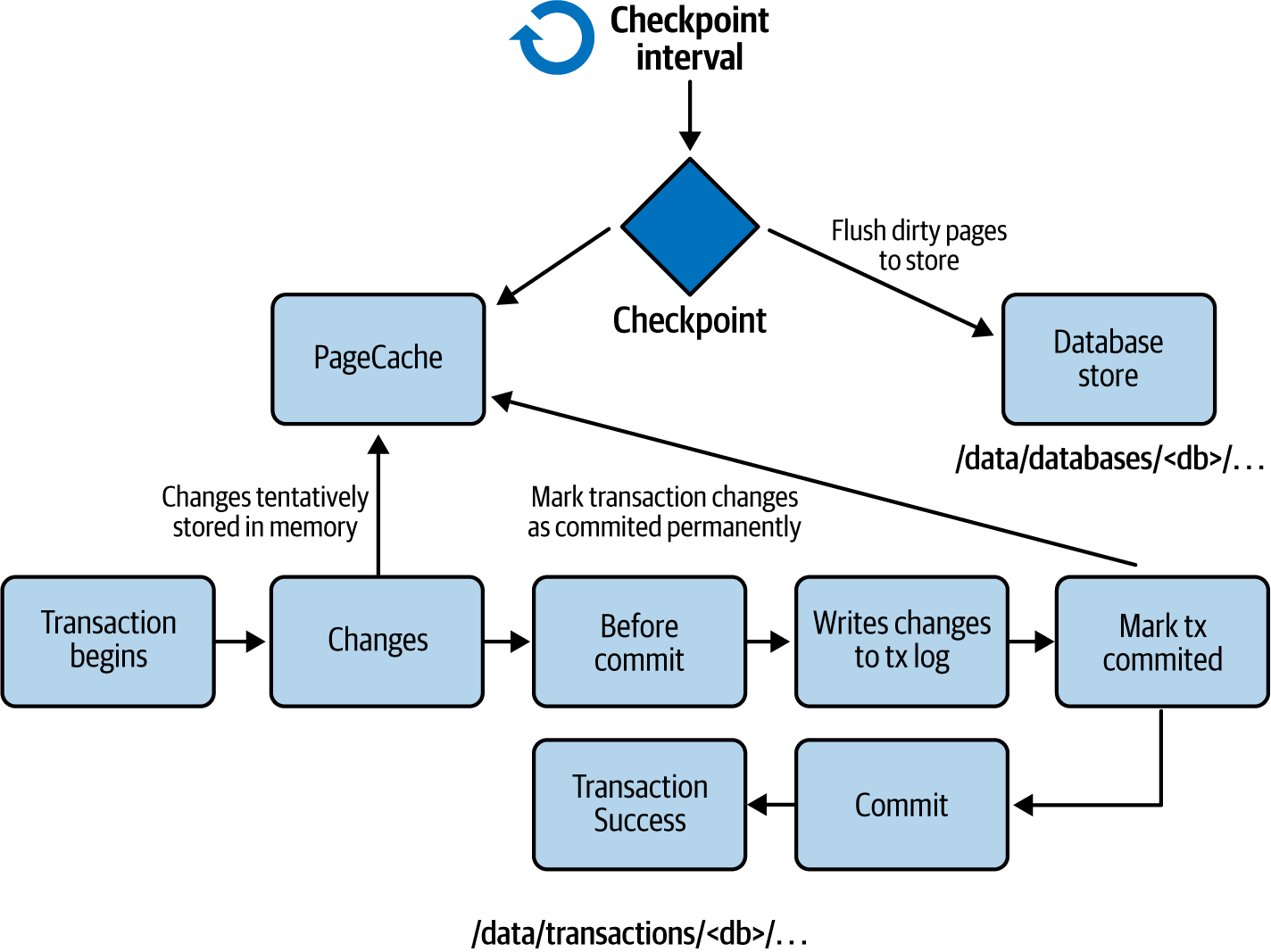
Recall from Chapter 2 that a transaction starts when changes are made in the database. These changes are initially applied in memory and stored in the page cache, which acts as an intermediary layer before the data is eventually written ...
Read now
Unlock full access


 O’Reilly covers everything we've got, with content to help us build a world-class technology community, upgrade the capabilities and competencies of our teams, and improve overall team performance as well as their engagement.I wanted to learn C and C++, but it didn't click for me until I picked up an O'Reilly book. When I went on the O’Reilly platform, I was astonished to find all the books there, plus live events and sandboxes so you could play around with the technology.I’ve been on the O’Reilly platform for more than eight years. I use a couple of learning platforms, but I'm on O'Reilly more than anybody else. When you're there, you start learning. I'm never disappointed.I'm always learning. So when I got on to O'Reilly, I was like a kid in a candy store. There are playlists. There are answers. There's on-demand training. It's worth its weight in gold, in terms of what it allows me to do.