June 2001
Intermediate to advanced
320 pages
8h 32m
English
Now that you are familiar with the major goals of the .NET Framework, let’s briefly examine its architecture. As you can see in Figure 1-2, the .NET Framework sits on top of the operating system, which can be a few different flavors of Windows,[3] and consists of a number of components. (Each of these components is discussed in greater detail starting with Chapter 4, as described in the Preface.) .NET is essentially a system application that runs on Windows.
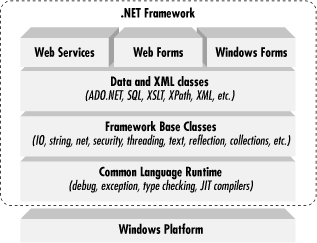
Figure 1-2. The .NET Framework
The most important component of the Framework is something called the CLR. If you are a Java programmer, think of the CLR as the .NET equivalent of the Java Virtual Machine ( JVM). If you don’t know Java, think of the CLR as the heart and soul of the .NET architecture. At a high level, the CLR activates objects, performs security checks on them, lays them out in memory, executes them, and garbage-collects them.
Conceptually, the CLR and the JVM are similar in that they are both runtime infrastructures that abstract the underlying platform differences. However, while the JVM currently supports just the Java language, the CLR supports all languages that can be represented in the Common Intermediate Language (CIL). The JVM executes bytecode, so it could technically support many different languages, too. Unlike Java’s bytecode, though, IL is never interpreted. Another conceptual difference ...
Read now
Unlock full access


 O’Reilly covers everything we've got, with content to help us build a world-class technology community, upgrade the capabilities and competencies of our teams, and improve overall team performance as well as their engagement.I wanted to learn C and C++, but it didn't click for me until I picked up an O'Reilly book. When I went on the O’Reilly platform, I was astonished to find all the books there, plus live events and sandboxes so you could play around with the technology.I’ve been on the O’Reilly platform for more than eight years. I use a couple of learning platforms, but I'm on O'Reilly more than anybody else. When you're there, you start learning. I'm never disappointed.I'm always learning. So when I got on to O'Reilly, I was like a kid in a candy store. There are playlists. There are answers. There's on-demand training. It's worth its weight in gold, in terms of what it allows me to do.