December 2014
Intermediate to advanced
274 pages
6h 8m
English
In this chapter, I’ll take you step by step through building your first, simple Chrome App. I’ll explain the key differences between a Chrome App and an ordinary web app of the sort with which you may already be familiar. I’ll tell you how to run your app, how to use the new Chrome Dev Editor, and how to publish it to the Chrome Web Store.
To build this first Chrome App, let’s begin with something you already know how to build: a simple web app that converts meters to feet, as shown in Figure 1-1. To use the app, you enter an amount of meters in the first field and then click the Convert button. The app then displays the equivalent amount in feet in the second field.
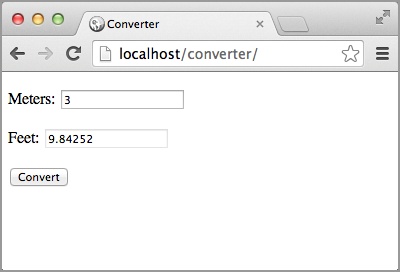
Like all web apps, the user interface for our sample app is built from an HTML file, (index.html), which you can see in the following:
<!DOCTYPE html>
<html lang="en">
<head>
    <meta charset="utf-8" />
    <title>Converter</title>
    <script src="converter.js"></script>
</head>
<body>
    <p>
        <label for="meters">Meters:</label>
        <input type="text" id="meters">
    </p><p>
        <label for="feet">Feet:</label>
        <input type="text" id="feet" readonly>
    </p><p>
        <button id="convert">Convert</button>
    </p>
</body>
</html>
The <script> tag brings in the following JavaScript, which is in the file converter.js:
window.onload = function () { document.querySelector("#convert").addEventListener("click", ...Read now
Unlock full access


 O’Reilly covers everything we've got, with content to help us build a world-class technology community, upgrade the capabilities and competencies of our teams, and improve overall team performance as well as their engagement.I wanted to learn C and C++, but it didn't click for me until I picked up an O'Reilly book. When I went on the O’Reilly platform, I was astonished to find all the books there, plus live events and sandboxes so you could play around with the technology.I’ve been on the O’Reilly platform for more than eight years. I use a couple of learning platforms, but I'm on O'Reilly more than anybody else. When you're there, you start learning. I'm never disappointed.I'm always learning. So when I got on to O'Reilly, I was like a kid in a candy store. There are playlists. There are answers. There's on-demand training. It's worth its weight in gold, in terms of what it allows me to do.