January 2026
Beginner to intermediate
272 pages
6h 31m
English
Take a step back and think about what Microsoft Excel does. Sure, Excel allows you to analyze data using pivot tables and charts. However, it must first do something more fundamental – Microsoft Excel must store data.
You can think of Excel as storing data in multiple ways:
Intuitively, you can think of all these as being containers in which you store data. Just like in the real world, each type of container has different capabilities for storing data.
Consider an Excel worksheet. It provides you with the capabilities of storing data in terms of rows and columns. Similarly, an Excel table does the same thing but provides additional capabilities (e.g. header filters).
Worksheets and tables are examples of Excel’s built-in data structures. Data structures provide functionality for storing, organizing, and managing data based on rules.
Just as skills with worksheets and tables are fundamental to being successful with Excel, so it is with learning Python’s most important built-in data structures.
Imagine that you’re about to head out to purchase some groceries. Like so many, you make a list of what you need to make sure you don’t forget anything. You could use Excel to write your grocery list, as shown in Figure 3.1.
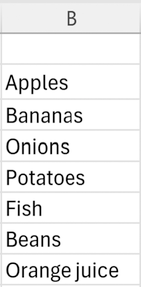
Figure 3-1: Your Grocery List.
Think about Figure 3.1 for a second. Conceptually, the grocery ...
Read now
Unlock full access


 O’Reilly covers everything we've got, with content to help us build a world-class technology community, upgrade the capabilities and competencies of our teams, and improve overall team performance as well as their engagement.I wanted to learn C and C++, but it didn't click for me until I picked up an O'Reilly book. When I went on the O’Reilly platform, I was astonished to find all the books there, plus live events and sandboxes so you could play around with the technology.I’ve been on the O’Reilly platform for more than eight years. I use a couple of learning platforms, but I'm on O'Reilly more than anybody else. When you're there, you start learning. I'm never disappointed.I'm always learning. So when I got on to O'Reilly, I was like a kid in a candy store. There are playlists. There are answers. There's on-demand training. It's worth its weight in gold, in terms of what it allows me to do.