January 2002
Intermediate to advanced
240 pages
6h 58m
English
In Chapter 2, Section 2.2.3 briefly discussed the concept of an XML pipeline. In that simple case, it involved reading, transforming, and then writing XML text. This concept is a powerful model for working with SAX; it is the natural framework for developing SAX components. These components won’t usually be JavaBeans-style components, intended for use with graphical code builder tools, but they will still be specialized and easily reusable.
Exactly what is a SAX event pipeline? It’s a series of components, each a pipeline stage connected so consumers act as producers for the next stage, as shown in Figure 4-1. The components pass events through, perhaps changing them on the fly to filter, reorganize, augment, or otherwise transform the data as it streams through. (The term filter is sometimes used to mean the same thing as a stage, though it’s only one type of role for a stage.) The first producer could be a parser, or some other program component. The last consumer will probably have some defined output, such as XML text (XMLWriter), a DOM document (using the classes shown earlier), or an application-specific data structure. Intermediate stages in the pipeline have at least one pipeline stage as output, and they might produce other outputs such as data structures. Or they might only be used to analyze or condition the inputs to later stages.
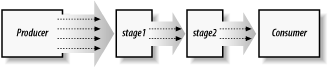
Figure 4-1. SAX2 ...
Read now
Unlock full access


 O’Reilly covers everything we've got, with content to help us build a world-class technology community, upgrade the capabilities and competencies of our teams, and improve overall team performance as well as their engagement.I wanted to learn C and C++, but it didn't click for me until I picked up an O'Reilly book. When I went on the O’Reilly platform, I was astonished to find all the books there, plus live events and sandboxes so you could play around with the technology.I’ve been on the O’Reilly platform for more than eight years. I use a couple of learning platforms, but I'm on O'Reilly more than anybody else. When you're there, you start learning. I'm never disappointed.I'm always learning. So when I got on to O'Reilly, I was like a kid in a candy store. There are playlists. There are answers. There's on-demand training. It's worth its weight in gold, in terms of what it allows me to do.