June 2027
Intermediate to advanced
350 pages
10h 4m
English
Search engines rely on far more than clever indexing to achieve real-world performance. Beneath every fast query response is a carefully engineered storage layer. As illustrated in Figure 4-1, this layer should balance write throughput, read latency, durability, and scale. Unlike traditional analytics engines, which favor columnar formats optimized for large scans ideal for aggregation use cases, search engines require data structures that support low-latency random access, rapid document filtering, and complex scoring. These capabilities must also juggle frequent writes, updates, and deletions.
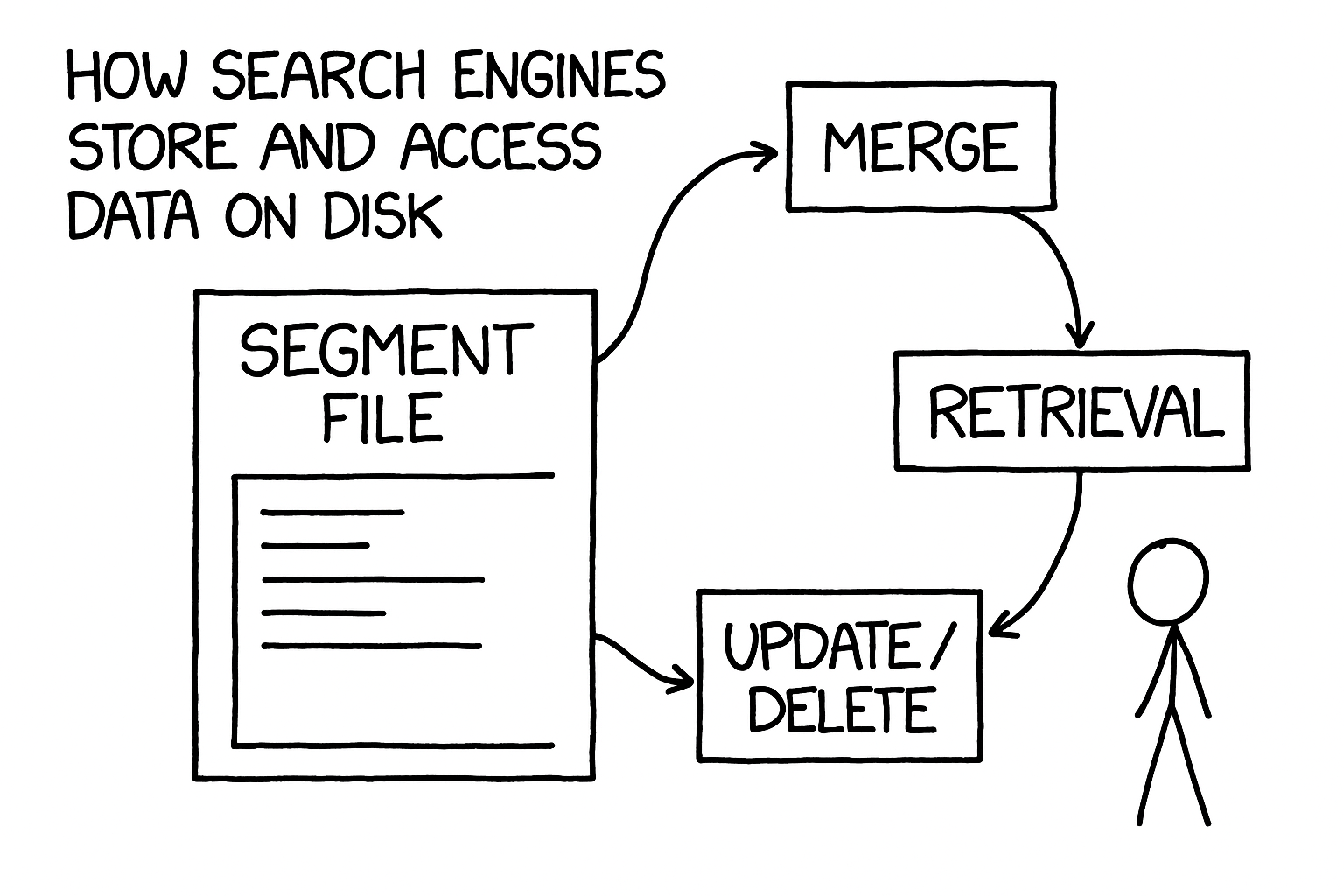
This chapter covers how modern search engines persist indexed content to disk, and how that layout enables (or limits) future retrieval. We explore the concept of a segment file as the core ...
Read now
Unlock full access


 O’Reilly covers everything we've got, with content to help us build a world-class technology community, upgrade the capabilities and competencies of our teams, and improve overall team performance as well as their engagement.I wanted to learn C and C++, but it didn't click for me until I picked up an O'Reilly book. When I went on the O’Reilly platform, I was astonished to find all the books there, plus live events and sandboxes so you could play around with the technology.I’ve been on the O’Reilly platform for more than eight years. I use a couple of learning platforms, but I'm on O'Reilly more than anybody else. When you're there, you start learning. I'm never disappointed.I'm always learning. So when I got on to O'Reilly, I was like a kid in a candy store. There are playlists. There are answers. There's on-demand training. It's worth its weight in gold, in terms of what it allows me to do.