March 2006
Intermediate to advanced
576 pages
11h 43m
English
The B's complement adder of Figure 11.46a is deduced from Algorithm 4.18. It consists of an (n + 1)-digit adder and two instances of the combinational circuit ext (digit extension) whose function is to represent x and y with an additional digit (sign digit):

Another circuit is shown in Figure 11.46b. Instead of generating an (n + 1)-digit output, this second adder generates an n-digit output and an overflow flag (Equation 4.17) is raised if the result cannot be expressed with n digits.
TABLE 11.4 Experimental Results
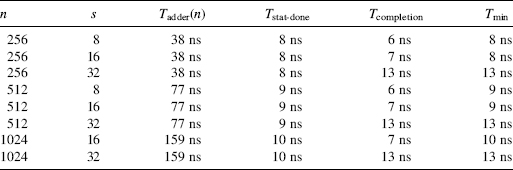

Figure 11.46 B's complement adders.
In order to synthesize a subtractor, or an adder-subtractor, another type of combinational circuit, namely, inv, is necessary. Given an n-digit number a, it computes

Two versions of a B's complement adder-subtractor are shown in Figure 11.47. The first one generates the exact (n + 1)-digit result. The other one generates an n-digit result and an overflow flag according to the relations (4.17) and (4.20). In both circuits the control signal defines the operation: addition (control ...