August 2025
Intermediate to advanced
124 pages
3h 7m
English
The earlier chapters identified many questions about how your business deals with distributed data. How do you collect that data to make it accessible to all your employees in a single unified format and location? How do you govern the data to ensure that it is accurate while also being secure? How do you create centralized accessible data while still maintaining the granularity and detail needed for domain-specific reporting?
These questions all challenge modern business methods for data management, and two approaches have been developed to tackle these problems: data fabric and data mesh. However, as we shall see, they approach the problem in different ways. This chapter digs into both of these solutions and uncovers how logical data management is the basis for both.
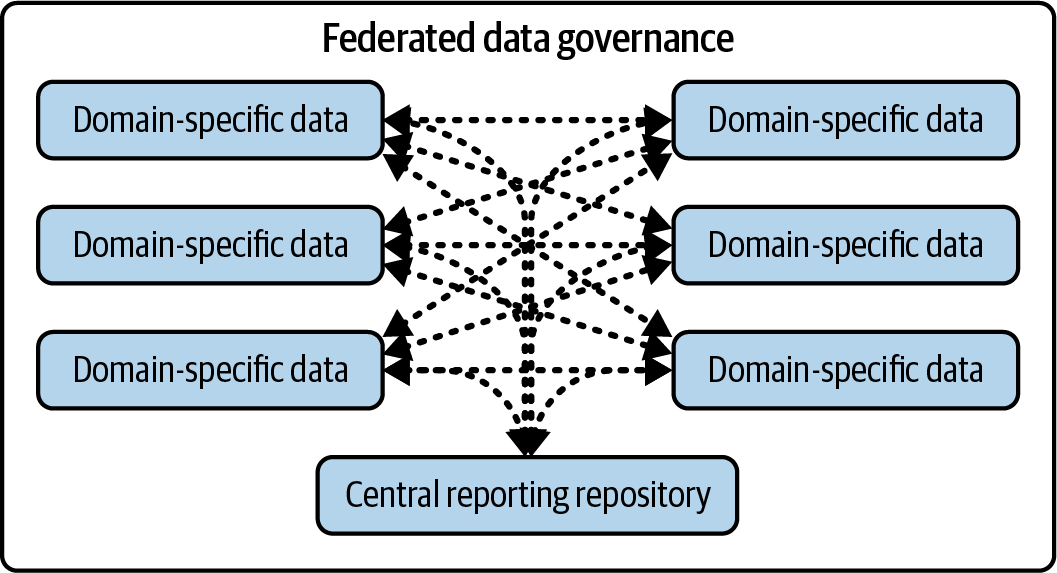
A data mesh is a mix of technical and business practices that empower domains within a company to manage and maintain their own data (see Figure 3-1). This approach enables them to meet their reporting needs without needing to force the data into a centralized governed structure. While some aspects of the data are controlled centrally through federated data management, the remainder is left to the specific data domain to maintain.
Read now
Unlock full access


 O’Reilly covers everything we've got, with content to help us build a world-class technology community, upgrade the capabilities and competencies of our teams, and improve overall team performance as well as their engagement.I wanted to learn C and C++, but it didn't click for me until I picked up an O'Reilly book. When I went on the O’Reilly platform, I was astonished to find all the books there, plus live events and sandboxes so you could play around with the technology.I’ve been on the O’Reilly platform for more than eight years. I use a couple of learning platforms, but I'm on O'Reilly more than anybody else. When you're there, you start learning. I'm never disappointed.I'm always learning. So when I got on to O'Reilly, I was like a kid in a candy store. There are playlists. There are answers. There's on-demand training. It's worth its weight in gold, in terms of what it allows me to do.