November 2011
Intermediate to advanced
368 pages
15h 6m
English
Typographic messages pervade our culture to the degree that they are often taken for granted or not noticed at all. Typographic messages are most effective when they are distinguished from the competition. Messages that clearly communicate and are etched into the mind and memory are those characterized by absolute clarity in form and content. This chapter introduces typography as a language of potent visible signs, a language capable of educating, persuading, informing, and entertaining. When typographic signs are created with an informed eye and mind, they achieve both lucidity and aesthetic beauty.
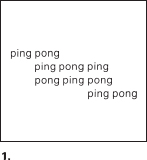
1. “ping pong” (Poet: Eugen Gomringer)

4. Title lettering for De Stijl. (Designer: Theo van Doesburg)
The typographic message is verbal, visual, and vocal. While typography is read and interpreted verbally, it may also be viewed and interpreted visually, heard and interpreted audibly. It is a dynamic communication medium. In this sense, early twentieth-century typography became a revolutionary form of communication, bringing new expressive power to the written word. Consider the concrete poem “ping pong” (Fig. 1). The geometric structure of this poem is composed of a repetition of the words ping and pong. As these words are repeated, ...
Read now
Unlock full access


 O’Reilly covers everything we've got, with content to help us build a world-class technology community, upgrade the capabilities and competencies of our teams, and improve overall team performance as well as their engagement.I wanted to learn C and C++, but it didn't click for me until I picked up an O'Reilly book. When I went on the O’Reilly platform, I was astonished to find all the books there, plus live events and sandboxes so you could play around with the technology.I’ve been on the O’Reilly platform for more than eight years. I use a couple of learning platforms, but I'm on O'Reilly more than anybody else. When you're there, you start learning. I'm never disappointed.I'm always learning. So when I got on to O'Reilly, I was like a kid in a candy store. There are playlists. There are answers. There's on-demand training. It's worth its weight in gold, in terms of what it allows me to do.