June 2024
Beginner
5 pages
2m
English
You have a PivotTable and want to use two or more fields for its rows.
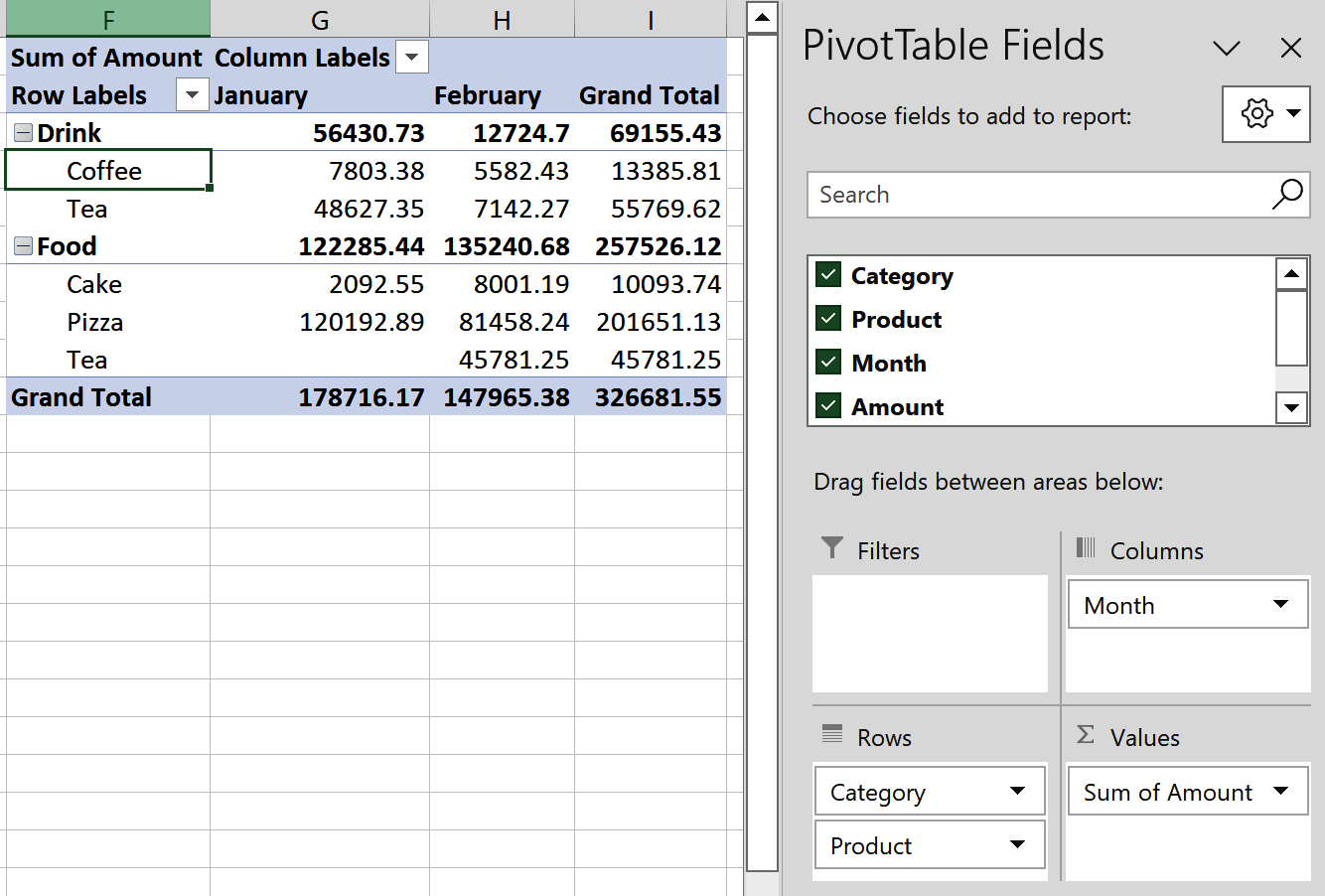
Suppose you have an empty PivotTable based on a table of sales data with columns named Category, Product, Month, and Amount. You want to calculate the total amount for each category, product, and month.
You can solve this problem using secondary rows. You add secondary rows by following these steps:
Drag the Category field in the Fields section to the Rows section; then drag the Product field to the Rows section, placing it underneath the Category field. This adds secondary rows to the PivotTable so each Product value appears under the relevant Category.
Drag the Month field to the Columns section and the Amount field to the Values section; this calculates the sum of the amount values for each category, product, and month.
Figure 1 shows the resulting PivotTable and its PivotTable Fields pane.
You can also add secondary rows by drilling down into the data. Double-click a row or column item in the PivotTable; then use the Show Detail dialog box to specify which data you want to display.
Secondary rows let you slice, dice, and group your PivotTable data and include summary values for different combinations. You can also include secondary columns ...
Read now
Unlock full access


 O’Reilly covers everything we've got, with content to help us build a world-class technology community, upgrade the capabilities and competencies of our teams, and improve overall team performance as well as their engagement.I wanted to learn C and C++, but it didn't click for me until I picked up an O'Reilly book. When I went on the O’Reilly platform, I was astonished to find all the books there, plus live events and sandboxes so you could play around with the technology.I’ve been on the O’Reilly platform for more than eight years. I use a couple of learning platforms, but I'm on O'Reilly more than anybody else. When you're there, you start learning. I'm never disappointed.I'm always learning. So when I got on to O'Reilly, I was like a kid in a candy store. There are playlists. There are answers. There's on-demand training. It's worth its weight in gold, in terms of what it allows me to do.