June 2026
Intermediate to advanced
408 pages
10h 3m
English
The when and how of events unfolding over time is what separates interpreting a photo from understanding a story: the world doesn’t stand still. What is the deer in Figure 9-1 doing in the street? Looking at the multiple frames, we see it is in a park, and people are not scared but are enjoying observing and interacting with it.
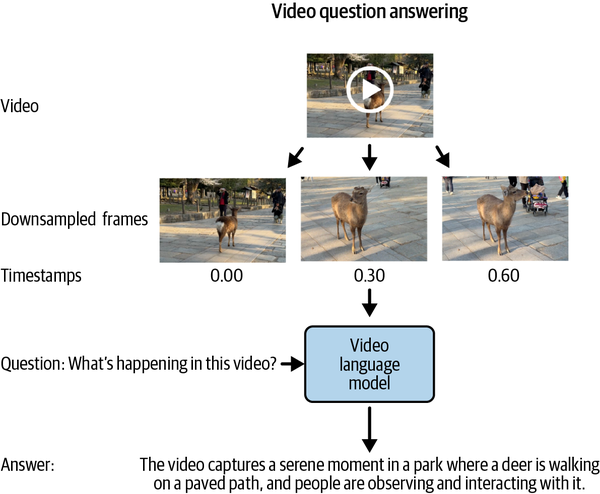
Videos contain everything images do plus time. The temporal dimension is deceptively expensive: 300 frames per 10-second clip, quadratic attention costs that explode with sequence length, and motion patterns that require understanding not just what objects are but how they move. A strong image classifier might nail every frame individually but completely miss the action that ties them together.
In this chapter, you will learn how video-language models tackle these challenges. You will see how temporal modeling mechanisms capture motion and event sequences, how attention strategies scale to handle hundreds of frames while fitting in a GPU, and how to combine embedding and generative models into practical pipelines that work at scale.
By the end of this chapter, you will:
Understand how video models evolved from 3D convolutional neural networks (CNNs) to modern transformer architectures and why factorization ...
Read now
Unlock full access


 O’Reilly covers everything we've got, with content to help us build a world-class technology community, upgrade the capabilities and competencies of our teams, and improve overall team performance as well as their engagement.I wanted to learn C and C++, but it didn't click for me until I picked up an O'Reilly book. When I went on the O’Reilly platform, I was astonished to find all the books there, plus live events and sandboxes so you could play around with the technology.I’ve been on the O’Reilly platform for more than eight years. I use a couple of learning platforms, but I'm on O'Reilly more than anybody else. When you're there, you start learning. I'm never disappointed.I'm always learning. So when I got on to O'Reilly, I was like a kid in a candy store. There are playlists. There are answers. There's on-demand training. It's worth its weight in gold, in terms of what it allows me to do.