May 2024
Intermediate to advanced
48 pages
1h 5m
English
A large language model (LLM) is a statistical model trained on large amounts of text data to emulate human speech for natural language processing tasks (Figure 1-1), such as information extraction, text classification, speech synthesis, summarization, and machine translation. LLMOps, thus, is a framework to automate and streamline large language model (also called a foundational or generative AI model) pipelines.
While task-specific models for natural language processing (NLP) have been used in practice for a while, recent advances in NLP have shifted public interest to more task-agnostic models that allow a single model to do all of the tasks listed in the preceding paragraph.
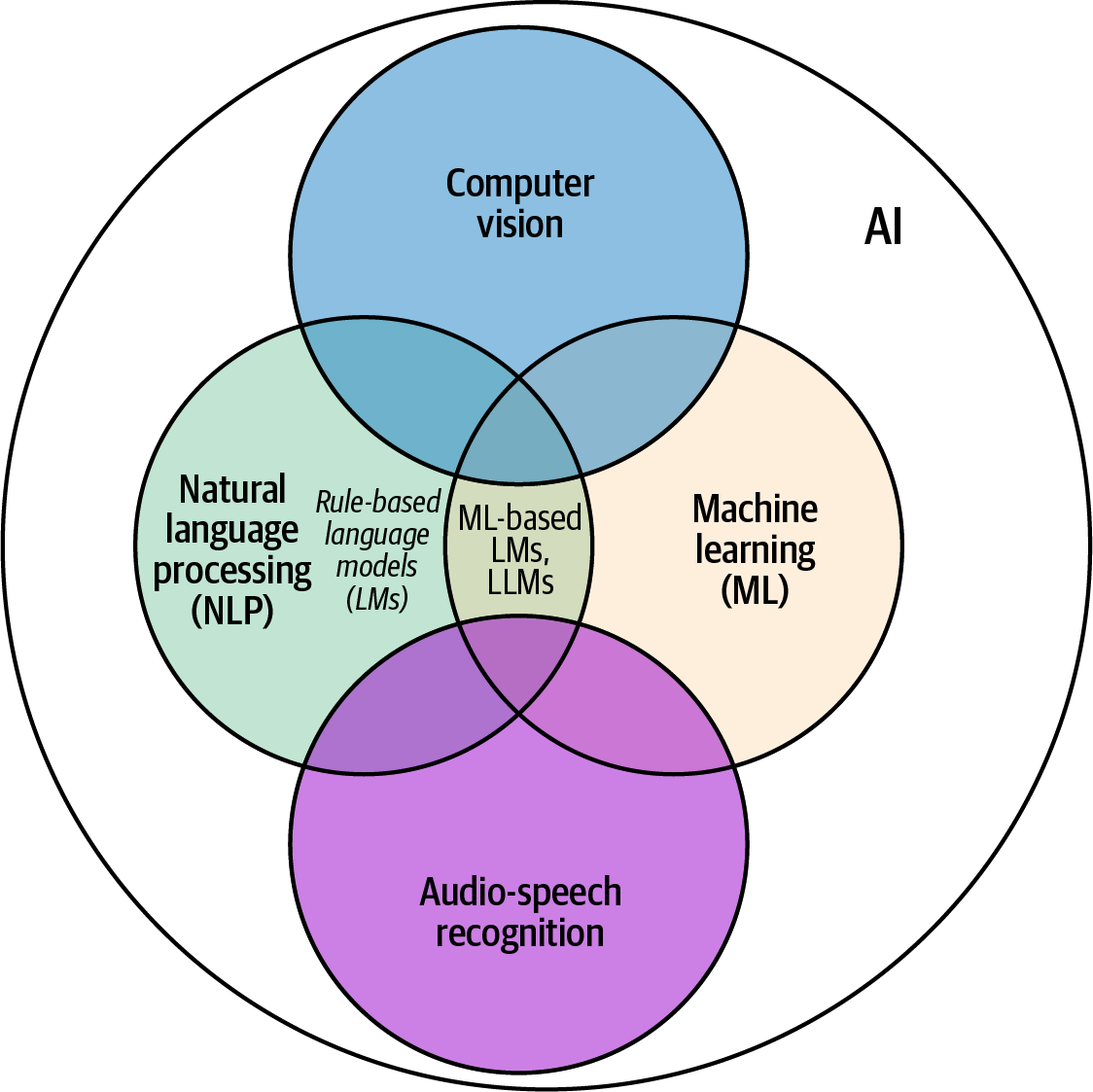
LLMs do this by using a large number of parameters (variables that store input-output patterns in the data to help the model make predictions): LLaMA, an LLM developed by Meta, contains 65 billion parameters; PaLM, by Google, has 540 billion; and GPT-4, developed by OpenAI, is estimated to have about 1.7 trillion. These parameters allow them to capture massive amounts of linguistic and contextual information about the world and perform well on a wide range of tasks.
As such, LLMs can be used in chatbots, coding assistance tools, and many other kinds of applications. Essentially, any information ...
Read now
Unlock full access


 O’Reilly covers everything we've got, with content to help us build a world-class technology community, upgrade the capabilities and competencies of our teams, and improve overall team performance as well as their engagement.I wanted to learn C and C++, but it didn't click for me until I picked up an O'Reilly book. When I went on the O’Reilly platform, I was astonished to find all the books there, plus live events and sandboxes so you could play around with the technology.I’ve been on the O’Reilly platform for more than eight years. I use a couple of learning platforms, but I'm on O'Reilly more than anybody else. When you're there, you start learning. I'm never disappointed.I'm always learning. So when I got on to O'Reilly, I was like a kid in a candy store. There are playlists. There are answers. There's on-demand training. It's worth its weight in gold, in terms of what it allows me to do.