April 2019
Beginner
350 pages
11h 9m
English
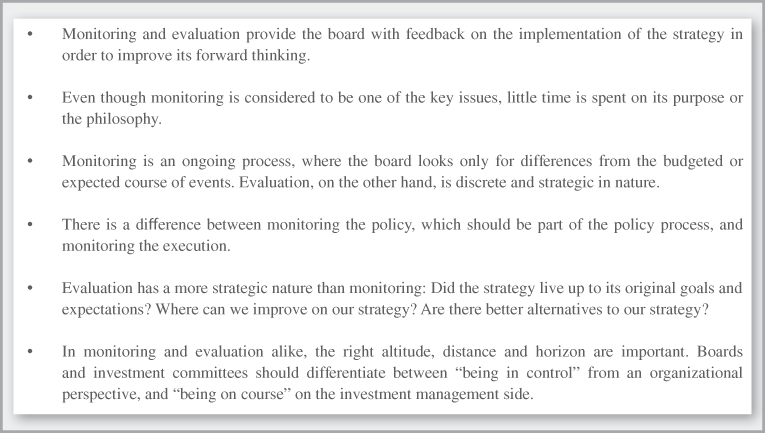
An important responsibility of trustees is, for all the parts of the process, to monitor and evaluate the overall strategy and selected investment managers. Once the board has decided on the investment strategy, who will implement the different steps and how these will be implemented (e.g. mandate, risk budget), the implementation is set in motion. At this stage, you will want to track whether your fund is performing as you expected in order to alter the strategy or its implementation if necessary. This is not an easy task, mainly because of the fact that capital market outcomes are noisy in the short term: this makes it easy to mistake bad luck (short-term underperformance) for poor skills, and base costly decisions, such as firing and replacing managers, on this. Many behavioral traps come into play at this stage, from a committee shifting into action bias by firing an external manager when there is an underperformance, to the disappointment of trustees, who spent a great deal of time selecting and hiring a manager who subsequently performed below expectations. A high manager turnover rate is a signal that reflects poorly on an investment committee.
Selecting mandates leads to a substantial amount of work for the investment consultants and staff. Yet, once the mandate is selected, most time is spent on monitoring, evaluation, ...
Read now
Unlock full access


 O’Reilly covers everything we've got, with content to help us build a world-class technology community, upgrade the capabilities and competencies of our teams, and improve overall team performance as well as their engagement.I wanted to learn C and C++, but it didn't click for me until I picked up an O'Reilly book. When I went on the O’Reilly platform, I was astonished to find all the books there, plus live events and sandboxes so you could play around with the technology.I’ve been on the O’Reilly platform for more than eight years. I use a couple of learning platforms, but I'm on O'Reilly more than anybody else. When you're there, you start learning. I'm never disappointed.I'm always learning. So when I got on to O'Reilly, I was like a kid in a candy store. There are playlists. There are answers. There's on-demand training. It's worth its weight in gold, in terms of what it allows me to do.