April 2019
Beginner
350 pages
11h 9m
English
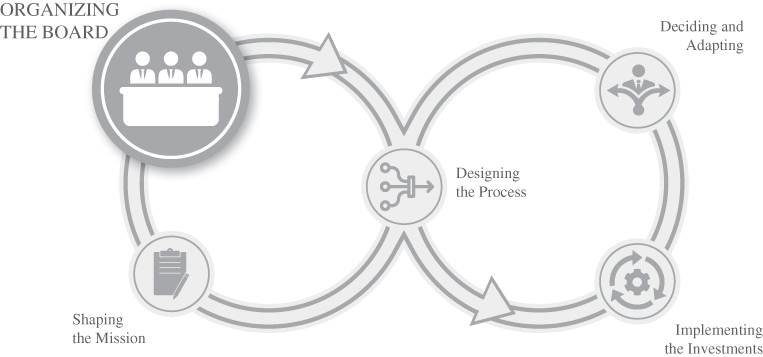
This section looks at the pension fund board from all angles. What are the characteristics of boards and their members, what should pension participants expect from them, how do members operate on boards, what attributes do board members need and how do they organize themselves?
Just as a new trustee would also do, we commence our examination of the pension fund board by reviewing the roles and responsibilities of the board and the characteristics of members, as well as by identifying the characteristics of successful boards and board members. This discussion is centered on maintaining “the right altitude—the right distance—the right horizon” for developing and monitoring the implementation of the strategy.
We examine the roles of boards as collective entities, as well as the parts that individual board members play. The way these members serve on a board, both individually and collectively, makes or breaks the quality of the outcome. Board member competence and knowledge is obviously an asset, but the selection process also highlights managing or representing different stakeholder groups as an important part of the required profile. How do board members balance these different interests?
Next, we move on to the roles and organization of the board staff or executive office, which is close to the board and supports board members in the formulation ...
Read now
Unlock full access


 O’Reilly covers everything we've got, with content to help us build a world-class technology community, upgrade the capabilities and competencies of our teams, and improve overall team performance as well as their engagement.I wanted to learn C and C++, but it didn't click for me until I picked up an O'Reilly book. When I went on the O’Reilly platform, I was astonished to find all the books there, plus live events and sandboxes so you could play around with the technology.I’ve been on the O’Reilly platform for more than eight years. I use a couple of learning platforms, but I'm on O'Reilly more than anybody else. When you're there, you start learning. I'm never disappointed.I'm always learning. So when I got on to O'Reilly, I was like a kid in a candy store. There are playlists. There are answers. There's on-demand training. It's worth its weight in gold, in terms of what it allows me to do.