June 2017
Beginner to intermediate
349 pages
8h 34m
English
In this chapter, our first agile sprint, we climb level 1 of the data-value pyramid (Figure 4-1). We will connect, or plumb, the parts of our data pipeline all the way through from raw data to a web application on a user’s screen. This will enable a single developer to publish raw data records on the web. In doing so, we will activate our stack against our real data, thereby connecting our application to the reality of our data and our users.
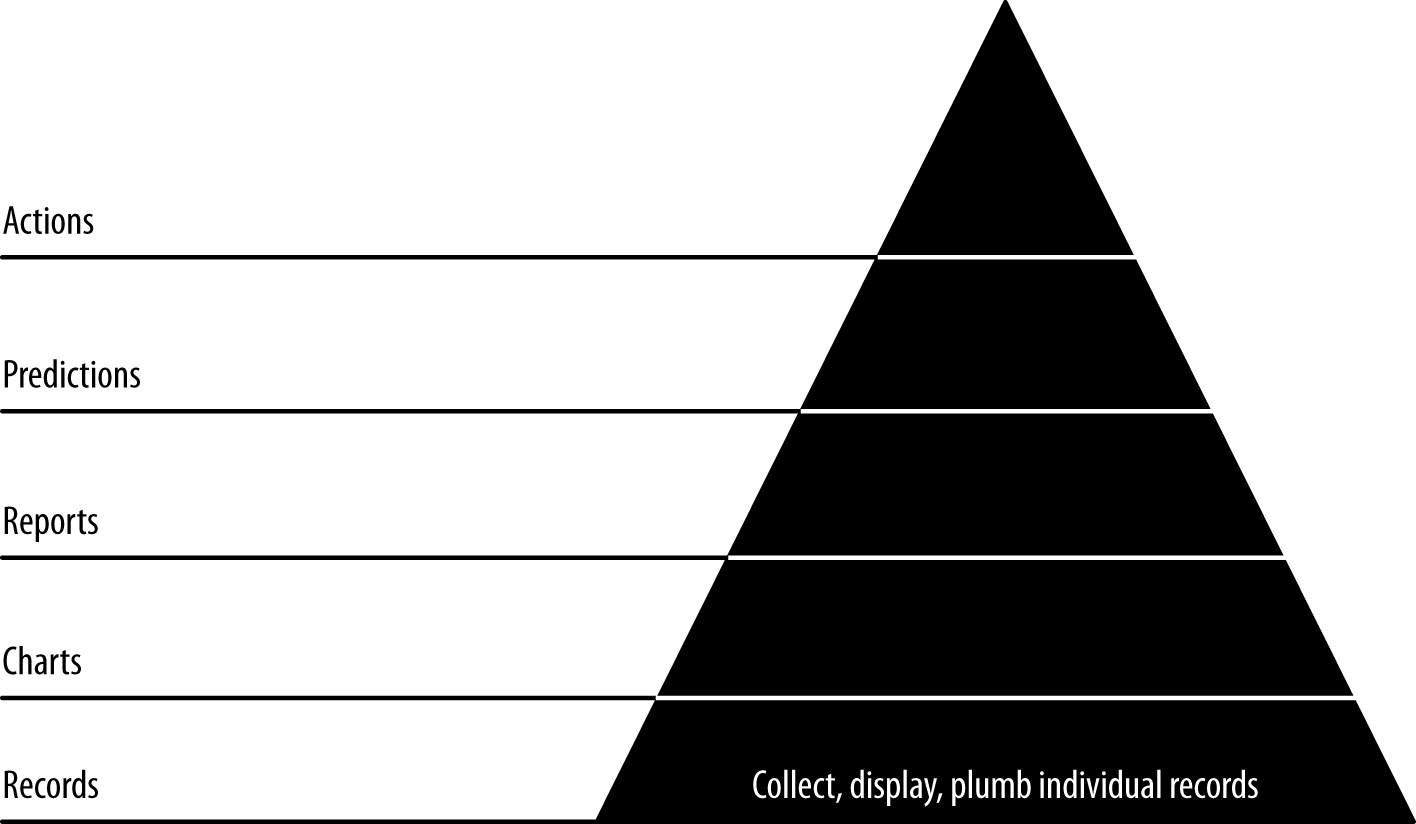
If you already have a popular application, this step may seem confusing in that you already have the individual (or atomic) records displaying in your application. The point of this step, then, is to pipe these records through your analytical pipeline to bulk storage and then on to a browser. Bulk storage provides access for further processing via ETL (extract, transform, load) or some other means.
This first stage of the data-value pyramid can proceed relatively quickly, so we can get on to higher levels of value. Note that we will return to this step frequently as we enrich our analysis with additional datasets. We’ll make each new dataset explorable as we go. We’ll be doing this throughout the book as we work through the higher-level steps. The data-value pyramid is something you step up and down in as you do your analysis and get feedback from users. This ...
Read now
Unlock full access


 O’Reilly covers everything we've got, with content to help us build a world-class technology community, upgrade the capabilities and competencies of our teams, and improve overall team performance as well as their engagement.I wanted to learn C and C++, but it didn't click for me until I picked up an O'Reilly book. When I went on the O’Reilly platform, I was astonished to find all the books there, plus live events and sandboxes so you could play around with the technology.I’ve been on the O’Reilly platform for more than eight years. I use a couple of learning platforms, but I'm on O'Reilly more than anybody else. When you're there, you start learning. I'm never disappointed.I'm always learning. So when I got on to O'Reilly, I was like a kid in a candy store. There are playlists. There are answers. There's on-demand training. It's worth its weight in gold, in terms of what it allows me to do.