September 2026
Intermediate to advanced
450 pages
11h 50m
English
Coding agents are some of the most potent types of AI agent in terms of the size of their likely impact. Code generation became one of the earliest applications of LLMs once they hit the scale of GPT-3 in 2020. As we saw in Chapter 3, code generation was also a major component for reasoning problems that reasoning LLMs tackle. Code is a key investment area for LLMs for two reasons. First, an enormous range of knowledge work, from software engineering to research, data analysis, and visualization, can be expressed as code. Second, and more useful for training, code can often be verified automatically: you can run it, or test it, and get a clear signal of whether it worked. That verifiability is what makes coding more tractable than open-ended tasks where there is no objective check.
This chapter walks through that world. We’ll meet the people who use and build code agents, see what makes software engineering agents distinct, build one ourselves, and finish with how the underlying code LLMs are trained.
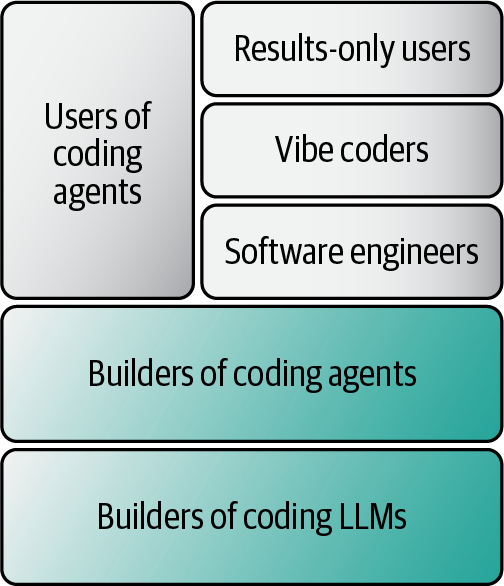
Before we get into how code agents are built, it helps to know who they’re for, because the people who use and build them have very different needs. Figure 10-1 lays out the cast.
Read now
Unlock full access


 O’Reilly covers everything we've got, with content to help us build a world-class technology community, upgrade the capabilities and competencies of our teams, and improve overall team performance as well as their engagement.I wanted to learn C and C++, but it didn't click for me until I picked up an O'Reilly book. When I went on the O’Reilly platform, I was astonished to find all the books there, plus live events and sandboxes so you could play around with the technology.I’ve been on the O’Reilly platform for more than eight years. I use a couple of learning platforms, but I'm on O'Reilly more than anybody else. When you're there, you start learning. I'm never disappointed.I'm always learning. So when I got on to O'Reilly, I was like a kid in a candy store. There are playlists. There are answers. There's on-demand training. It's worth its weight in gold, in terms of what it allows me to do.