June 2005
Beginner
412 pages
13h 45m
English
See more with both eyes.
Inexperienced astronomers often think of binoculars as poor substitutes for a telescope, something to use only if you don’t have a scope. That’s a mistake. In fact, a binocular is essential observing equipment even if you own a dozen top-notch telescopes. Experienced observers use binoculars to orient themselves within the constellation when they are locating objects they intend to view with their scopes—to place the object within its context of bright surrounding stars. A binocular is also useful for planning star hops [Hack #21] because the dimmest stars visible in a standard binocular are of similar magnitude to the dimmest stars visible in the optical finder of a typical telescope.
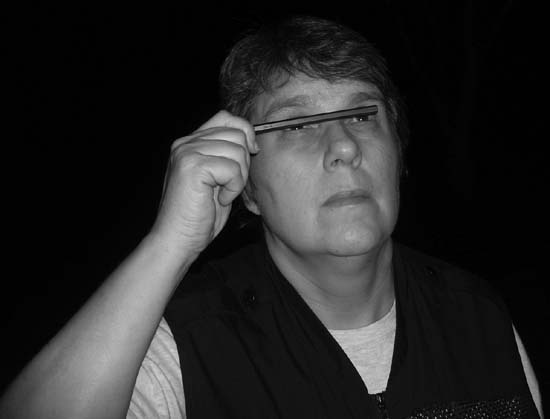
Figure 1-4. Barbara measures her entrance pupil using an Allen wrench
Binocular is properly a single noun. Calling a single instrument a “pair of binoculars” is incorrect. “May I use your binocular” is grammatically correct; “May I use your binoculars” isn’t, unless you mean two or more instruments. (Actually, asking to use someone’s binocular is an etiquette faux pas among astronomers—nearly equivalent to asking to borrow someone’s toothbrush—because most people have their personal binoculars adjusted to their own vision. If you do borrow a binocular, don’t change the diopter adjustment.)
But binoculars are more than just an adjunct to telescopic ...
Read now
Unlock full access


 O’Reilly covers everything we've got, with content to help us build a world-class technology community, upgrade the capabilities and competencies of our teams, and improve overall team performance as well as their engagement.I wanted to learn C and C++, but it didn't click for me until I picked up an O'Reilly book. When I went on the O’Reilly platform, I was astonished to find all the books there, plus live events and sandboxes so you could play around with the technology.I’ve been on the O’Reilly platform for more than eight years. I use a couple of learning platforms, but I'm on O'Reilly more than anybody else. When you're there, you start learning. I'm never disappointed.I'm always learning. So when I got on to O'Reilly, I was like a kid in a candy store. There are playlists. There are answers. There's on-demand training. It's worth its weight in gold, in terms of what it allows me to do.