December 2009
Beginner
320 pages
4h 33m
English
What we interpret as lines in optical reality are actually the contrasts between and among surfaces and tonal differences, as illustrated to the right.
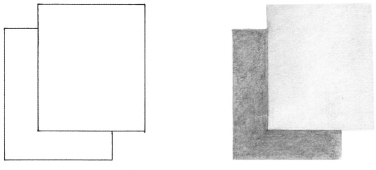
The choice of how one shades or renders these surfaces is ultimately a matter of fitness to purpose, style, and creativity.

The methods and styles for shading in surfaces can range from the lightest gestural suggestions to all the details and gradations of photorealistic rendering, and with everything in between.
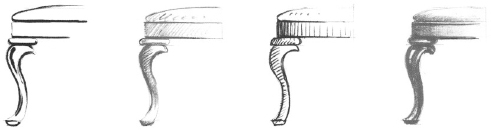
It is possible to suggest tonal differences and three-dimensional form by manipulating the weight of line alone. By making some lines darker and others lighter, highlights and shadows can be implied.
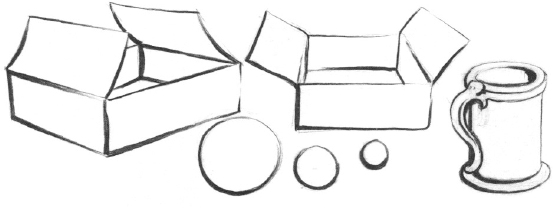
Surfaces tones can be indicated by dots, lines, hatching patterns, or virtually any kind of disturbance that sets off one area against another. In sketching, sometimes a simple squiggled line will not only be adequate but also most effective.
Using parallel lines is one way to get a surface. But notice the optical ...
Read now
Unlock full access


 O’Reilly covers everything we've got, with content to help us build a world-class technology community, upgrade the capabilities and competencies of our teams, and improve overall team performance as well as their engagement.I wanted to learn C and C++, but it didn't click for me until I picked up an O'Reilly book. When I went on the O’Reilly platform, I was astonished to find all the books there, plus live events and sandboxes so you could play around with the technology.I’ve been on the O’Reilly platform for more than eight years. I use a couple of learning platforms, but I'm on O'Reilly more than anybody else. When you're there, you start learning. I'm never disappointed.I'm always learning. So when I got on to O'Reilly, I was like a kid in a candy store. There are playlists. There are answers. There's on-demand training. It's worth its weight in gold, in terms of what it allows me to do.